Does Dry Mouth Cause Bad Breath
You may have already noticed a strange pattern: sometimes it is not that you skipped brushing, and it is not that your mouth feels obviously dirty or full of leftover residue, but the moment your mouth starts to feel dry, your breath becomes less stable. It is more noticeable when you first wake up, more noticeable after talking for a long time, more noticeable when you have not had enough water, and sometimes even after you have just finished your oral care routine, your mouth still feels dry, sticky, and not truly fresh. A lot of people interpret this as, “Maybe I still am not cleaning well enough.” But what often gets missed is not that you are brushing too little. It is that the moisture balance in your mouth may no longer be stable enough.
This article focuses on just one question: Can dry mouth cause bad breath? The answer is: it very likely can, and in many cases it does not create the problem on its own. Instead, it keeps amplifying an oral environment that is already not stable enough. NIDCR explains that saliva does far more than simply keep the mouth moist. It also helps control bacteria and fungi in the mouth and supports basic functions like chewing and swallowing. Mayo Clinic also lists dry mouth as one possible reason bad breath becomes more noticeable. In other words, dry mouth is not always the only cause, but it can absolutely be the key amplifier behind why the problem gets worse at certain times.

Dry Mouth Is Not Just Uncomfortable. It Can Make Your Oral Environment Easier to Throw Off Balance
A lot of people still think of dry mouth as nothing more than, “My mouth feels a little dry” or “I probably just need more water.” But the real problem is that saliva was never just there to make your mouth feel a little wetter. NIDCR makes this very clear: saliva not only helps with digestion, but also protects your teeth, helps control bacteria and fungi in the mouth, and allows you to chew and swallow more comfortably. That is exactly why when saliva drops, the issue is usually not just the sensation of dryness itself. The stability of your whole oral environment starts to drop with it.
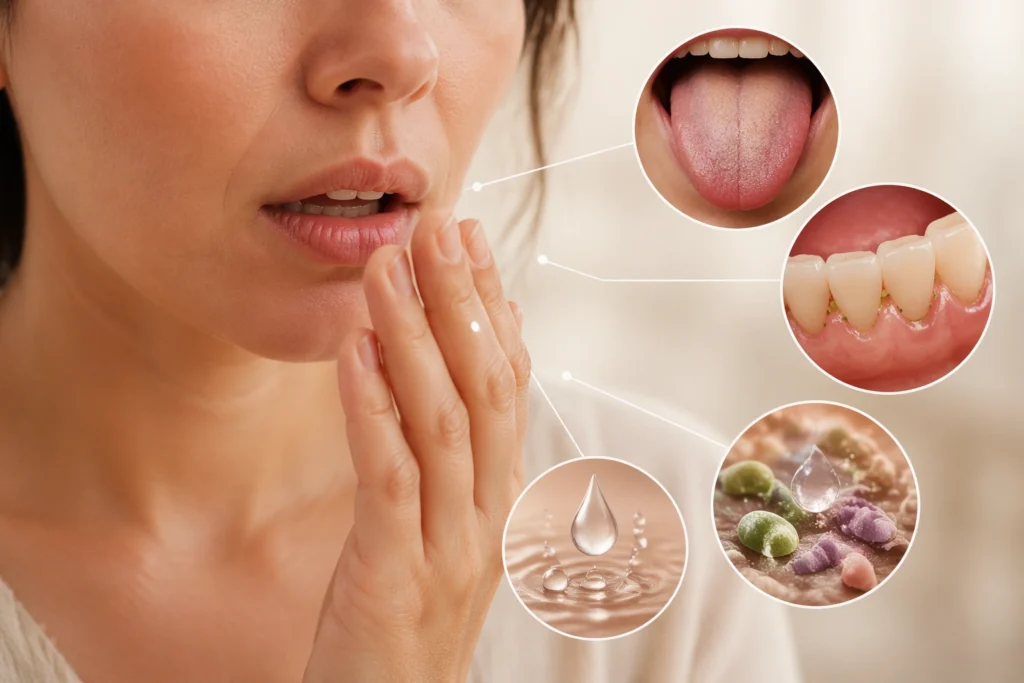
That is also why some people notice a very typical time-based pattern in their breath problem. It is not the same all day long. It gets worse in the morning, after long conversations, during stress, when you have not had enough water, when you breathe through your mouth, or when you have gone too long without eating. The issue is not necessarily that your mouth suddenly became dirtier in that moment. It is that once the moisture layer that helps maintain balance gets weaker, tongue coating, trapped residue between teeth, bacterial activity, and odor fluctuation all become easier to amplify. In other words, dry mouth often does not create the problem by itself. It makes what was already unstable much easier to notice.
Why Dry Mouth Can Make Bad Breath More Noticeable, Not Just Make Your Mouth Feel Dry
What really connects dry mouth to bad breath is not just surface-level discomfort. It is the fact that once saliva drops, your mouth loses part of its natural self-cleaning ability. Mayo Clinic explains that saliva normally helps clean the mouth and wash away particles that can cause odor. When dry mouth reduces saliva, that natural clearing process becomes weaker, and morning breath is often tied to the same nighttime dryness. In other words, the issue is not that dryness itself has a smell. It is that dryness allows the things that create smell to stay in place more easily.
That is why so many people have the same experience: right after brushing, things seem a little better, but before long the mouth starts to feel sticky, heavy, or stale again, and the fresh feeling does not last. This is especially true if you also deal with tongue coating, residue around the back teeth, poor interdental cleaning, or mouth breathing at night. In that situation, dry mouth works almost like an amplifier, pushing an existing but still somewhat controlled problem into something much more noticeable.
Why So Many People Already Know Their Mouth Feels Dry, Yet Still Have Not Really Addressed It Correctly
Because knowing dry mouth is there and truly treating it like a real layer of the problem are two very different things. A lot of people treat dryness as a side discomfort that is not important enough to address directly. Others instinctively keep moving toward “stronger cleaning,” such as harsher mouthwash, stronger mint sensation, or more frequent brushing. But that is exactly where the problem is. You are using stronger surface-level freshness to fight what is really more of an environment-stability problem underneath. That does not mean it has zero effect, but it often makes the whole pattern even less stable over time.
When your problem is clearly connected to dryness, the more useful next step is usually not to make your mouth feel more intense or more aggressively “clean.” It is to restore a more stable moisture environment first. Otherwise, it becomes very easy to get stuck in the same loop: your mouth feels dry → you feel uncomfortable → you use something stronger to suppress it → you get a short burst of freshness → then the dryness comes back again very quickly.
How to Tell Whether Your Bad Breath May Be Related to Dry Mouth
If your pattern sounds more like this, then dry mouth is worth taking seriously as a possible key layer: it is especially obvious when you wake up in the morning; it gets more uncomfortable after you have been talking for a long time; your mouth feels noticeably sticky when you have not had enough water; it does not always feel like something is physically stuck there, but more like the whole mouth feels “off”; brushing gives you a short period of relief, but the freshness does not last very long; or you also deal with things like medication use, mouth breathing, nasal congestion, late nights, or stress that can leave the mouth drier.
If the part that feels most familiar to you is, “The moment my mouth gets dry, the problem becomes much more noticeable,” then what you probably need most is not another cleaning step. You may need to treat dry mouth as its own layer instead of continuing to overlook it. For this kind of pattern, the real issue is often not whether you have done enough cleaning. It is that you have kept ignoring the amplifier that makes all your efforts feel unstable.
If You Already Suspect Dry Mouth Is the Key Layer, What Products Are More Worth Prioritizing at This Stage?
Once you have judged that you are probably stuck at the dry-mouth layer, the products most worth prioritizing are usually not stronger toothpaste or products that only create a short burst of freshness. What matters more are support tools that actually help your mouth stay moist and more stable. That is exactly why sugar-free gum, dry-mouth spray, dry-mouth lozenges, and moisture-support oral-care products are usually much more relevant here than simply adding more “intensity” to your routine.
If dry mouth is one of the main reasons your breath keeps becoming more noticeable, the most useful next step is usually not to clean harder, but to support the moisture layer that helps your mouth stay more stable. That is why the products below are the ones we would prioritize for this stage—they are more relevant for you whose breath gets worse after sleep, long conversations, or whenever the mouth starts to feel dry.
Best for Everyday Moisture Support
A simple way to help stimulate saliva and make the mouth feel less dry throughout the day.
Best for Quick Dry-Mouth Relief
A practical option when your mouth feels dry quickly and you want fast, targeted moisture support.
Best for Gentler Daily Support
A better fit for you who need ongoing support without using products that make the mouth feel even drier.
The products above are the priority for this stage, and the related articles below are there if you want to better understand the cause behind them.
If You Want a More Complete Way to Solve Bad Breath, We Also Have a Full Guide
The goal of this article is to help you judge whether dry mouth and bad breath may actually be connected in your case. But if you want a more complete solution to bad breath, we also have a full step-by-step guide that walks through the main causes, the right order to address them, and what to focus on next. Once you can see the full path more clearly, it becomes much easier to judge whether dry mouth is truly your core issue, or simply one layer within a bigger pattern.
If Your Problem Always Gets Worse When Your Mouth Feels Dry, What You May Really Need Is Not Stronger Cleaning, but a More Stable Oral Environment
A lot of people treat dry mouth like a small side issue, something that can wait as long as they are brushing carefully and trying to keep their breath fresh. But for many people who constantly feel like their breath is unstable, this is exactly the missing layer. It is not that you have done nothing for your oral care. It is that you have kept strengthening the actions you already know best, while continuing to overlook the environmental layer that keeps amplifying the problem.
Once you start treating dry mouth as a real priority, what changes is often not just whether your mouth feels less dry. It changes how stable your breath feels and how comfortable your mouth feels overall. That does not mean the issue disappears overnight. It means you are finally working on the amplifier that has been making everything feel like, “It gets a little better, then quickly slips again.” In many cases, real improvement does not come from stronger surface treatment. It comes from finally making your oral environment less likely to fall out of balance again.
Affiliate Disclosure:
Some of the links on this page may be affiliate links, which means we may earn a small commission if you make a purchase through them, at no extra cost to you. We only recommend products that are relevant to the topic and that we believe may be genuinely useful to you.
Based on trusted health sources:
*Mayo Clinic
*NHS
*National Institute of Dental and Craniofacial Research (NIDCR)
*Johns Hopkins Medicine