Best Interdental Brushes for Bad Breath
If you already brush carefully but your breath still feels stale, heavy, or slightly sticky from time to time, you may already be running into a layer that many people overlook: it is not that the tooth surfaces were missed, but that the between-teeth layer has never really been cleaned thoroughly. The NHS clearly recommends cleaning between your teeth at least once a day with floss or interdental brushes. The ADA also specifically includes floss or other interdental cleaners in its guidance for daily between-teeth cleaning, because brushing alone does not replace this step. For people who keep feeling, “I brushed, but my mouth still does not feel truly fresh,” or “it starts feeling off again later in the day,” this layer is often more important than switching to another toothpaste with a stronger mint flavor.
The problem is that interdental brushes are not something you just buy once and forget about. Whether you actually keep using them, whether they feel effective, whether they feel awkward, make your gums bleed, or end up sitting unused after a few days often has less to do with whether they are “popular” and more to do with whether they match your actual gap pattern. If the brush is too thick, it feels uncomfortable and may push you away from using it again. If it is too thin, you may feel like it is not doing enough. If the brush shape is wrong, the back teeth become annoying to reach. If the handle does not feel good in your hand, you will probably stop bothering with it after a short while. So what this page is really meant to do is not hand you a random list of generic picks. It is to help you first identify which situation sounds most like yours, and then which type of interdental brush is more worth buying first.

Why interdental brushes are directly connected to bad breath
A lot of recurring bad-breath problems do not come from the whole mouth being “dirty.” They come from small, repeated, local areas that never actually get cleaned properly. That can mean food and plaque between back teeth, buildup near the gumline, one little area that traps debris over and over, or corners your toothbrush never truly reaches. When those spots stay unstable for too long, you start getting a very specific kind of feeling: your teeth have been brushed, but your mouth still does not feel open, clean, or light enough. The NHS directly says that you should clean between your teeth with interdental brushes or floss at least once a day, and its page on keeping teeth clean also explains that if you have spaces between your teeth, interdental brushes can be used, and that the brush should snugly fit between the teeth. In other words, these are not optional little accessories. For many people, they are the missing step.
That is exactly why you should not only ask, “Which one is the best?” You need to ask, “Which type fits my gaps best?” For bad breath, what really matters is not whether you buy the most impressive-looking tool. It is whether you can consistently clear the layer that keeps building up in the places most likely to create recurrence. As long as that layer stays unstable from day to day, you will keep feeling like brushing solved half the issue but never really solved it all the way.
The first thing you need to judge is not which brush is best, but what kind of gap pattern you actually have
Let’s start with one of the most common situations: your gaps are relatively tight, but you already know brushing alone is not enough. If this sounds like you, you are probably not someone who ignores oral care. You are more likely someone who can clearly feel that certain spaces catch debris more easily, or that even after brushing, the spaces between the teeth still do not feel truly fresh. If you jump straight into a thick interdental brush, the experience usually will not be great. It can feel tight, uncomfortable, and discouraging. For you, the better first move is usually something slimmer, easier to insert, and more suitable for tight spaces. What you really need is not a tool that feels aggressive. You need a first brush that you can actually use consistently. The NHS specifically says the brush should snugly fit between the teeth, which already tells you that the right size matters more than “bigger equals stronger.”
If this sounds like your situation, then the best fit is usually not the big brush head that looks like some kind of “deep-cleaning tool.” You are usually better off starting with a type that is designed for tight gaps, narrow spaces, and easier daily starter use. That type is much more likely to help you build the habit, rather than making you quit after the first few tries.
If your problem sounds more like back teeth, larger spaces, or food that keeps getting trapped, then what you need is not “thinner,” but “better at lifting things out”
There is another type of person whose main problem is not whether the brush can get in, but whether it can actually pull things out once it does. You may know this feeling very well: certain spaces trap food over and over again, especially around the back teeth or larger gaps, and once those spots are not cleaned properly, the whole back half of your mouth starts to feel slightly off. You are not unfamiliar with brushing, but you are starting to realize that the real problem is not the surface. It is what stays stuck and never gets fully removed. If you keep using a brush that is too slim in this situation, it often ends up being “yes, it fits in, but no, it does not clean enough.” Then you feel like you did the step, but without real improvement.
For you, it usually makes more sense to prioritize interdental brushes that are better suited for slightly larger gaps, more plaque removal, and better debris lifting. The point is not force. It is that the brush size, bristle presence, and access to back teeth are more appropriate for what you are actually dealing with. What you are missing now is not a beginner tool. You need something that can actually bring trapped material out more effectively. If you already know you are the type who deals with food trapping and larger spaces, then the most useful next click is usually the product type built for larger spaces and trapped debris support.
If your gums get irritated or bleed easily when you try between-teeth tools, you need a gentler, more controllable version
Some people do not ignore between-teeth cleaning at all. They just get tense the moment they think about doing it. You may already have had unpleasant experiences before: it feels sore the moment it goes in, you see bleeding, or the gumline feels too irritated. Then you naturally reduce how often you do it, and before long you fall back into brushing alone. In guidance around gum disease, bad breath is often mentioned as one of the related signs. And in ADA Seal resources, the core benefit of interdental cleaners is described around helping remove plaque and helping prevent gingivitis between teeth. In other words, if your gumline is already unstable, then randomly using a brush that feels too strong or too rough is usually not the right move.
What makes more sense for you is usually a softer wire feel, a more flexible neck, and gentler daily control. What you need most right now is not a brush that cleans “harder.” It is one that you do not resist using, and that lets you approach the gumline more consistently without turning the whole step into something unpleasant. Once a tool helps you move from “I only do this occasionally” to “I can do this more naturally every day,” its impact on bad breath is often more practical than people expect.
If you keep buying them and then not using them, what you really need to prioritize is how easy they are to use
This is something people often underestimate. Many assume they need a more professional brush head, when what they actually need is a design they will truly keep using. A handle that feels too short, awkward grip, poor access to back teeth, annoying replacement steps, or inconvenient storage can all turn an effective tool into something you only use once in a while. And for recurring bad breath, using it once in a while is completely different from doing it consistently every day.
If your problem is not that you have never bought them before, but that you always stop after a few days, then your next best move is usually not “the strongest odor-control tool.” It is something more ergonomic, more back-tooth friendly, and easier to fit into a routine. At this point, your real problem is no longer knowledge. It is execution. Whether this step can smoothly become part of your regular brushing routine is what determines whether it can actually help stabilize that recurring bad-breath layer.
So between floss, a water flosser, and an interdental brush, which one is actually the better fit for you right now?
This is not really a “winner versus loser” question. It depends on where your current bottleneck is. The ADA says you should clean between your teeth daily with floss or another interdental cleaner. The NHS also says you can use interdental brushes or floss at least once a day. That means the real point is never that you must choose one side forever. The point is whether you can get this layer cleaned consistently. For many people with tight contacts, floss still absolutely has a place. For people with larger spaces, back-tooth issues, or food that keeps getting trapped, interdental brushes are often more direct. And if your gumline is particularly unstable and you also need broader rinsing support, a water flosser may work as a supportive layer.
But if you specifically searched for best interdental brushes for bad breath, that usually means you are already past the stage of asking, “Should I clean between my teeth at all?” You are really asking, “Which kind of interdental brush is the better match for me?” In that case, do not waste too much energy on broad tool comparisons. What you really need is to place yourself into the closest real-life usage pattern and choose the most suitable type first.
My Top Picks by Use Case
If you want the buying decision to feel simpler and more direct, this page is best read like this:
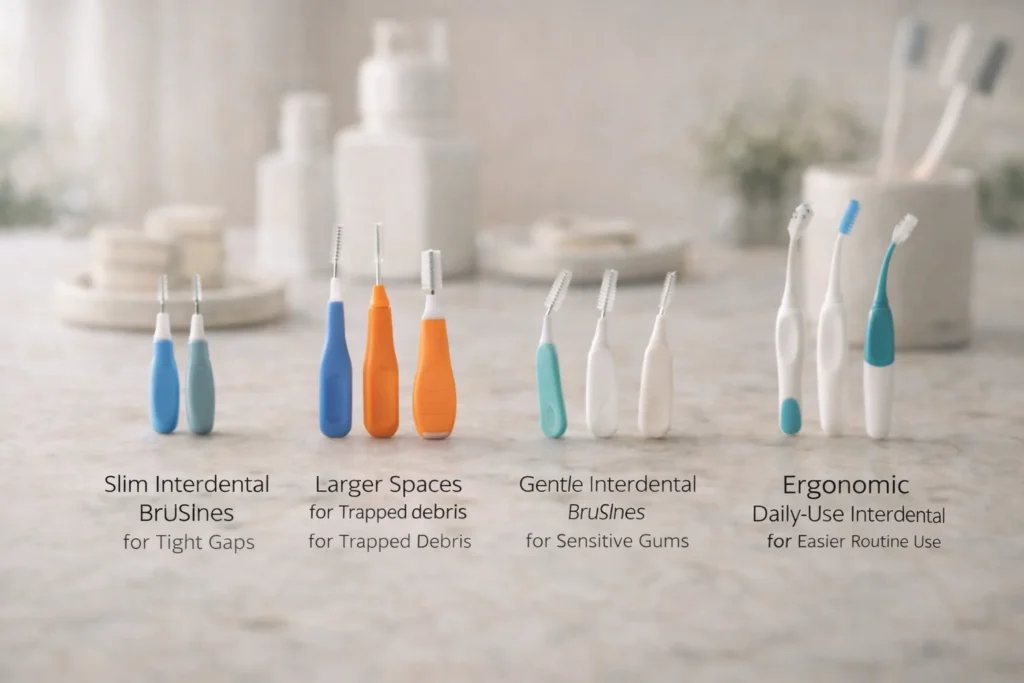
Best for Tight Gaps
This is the better fit if you already know between-teeth cleaning matters, but your gaps are tight, you worry about discomfort, and you mainly need something you can actually start using consistently. Prioritize slim, narrow, starter-friendly types.
Best for Larger Spaces and Trapped Debris
This is the better fit if certain areas, especially back teeth or larger spaces, keep trapping food and never feel properly clean afterward. Prioritize larger-gap, plaque-lifting, and better-reach types.
Best for Sensitive Gums
This is the better fit if your gumline feels easily irritated, past attempts have felt uncomfortable, and you need gentler daily control. Prioritize gentle, flexible, softer-feel types.
Best for Easy Daily Use
This is the better fit if you have bought these tools before but never stick with them. Prioritize handle comfort, back-tooth access, convenience, and routine-friendly design.
Which Type Are You?
If your most common feeling is, “I brushed, but it still does not feel truly fresh between the teeth,” and you do not obviously have large spaces or frequent food trapping, then you will probably do best starting with a tight gaps / slim daily type. What you need is not something intense right away. You need a version you can actually use every day without resisting it.
If you already know the problem is mostly in the back teeth, larger spaces, frequent food trapping, or one or two areas that never feel fully clean, then you are better off going straight to a larger-space / debris-lifting type. What you are missing now is not effort. It is whether anything is truly being pulled out.
If every time you think about between-teeth cleaning your first concern is gum discomfort, bleeding, or irritation, then you should prioritize a gentle gum-friendly type. What matters most for you is not cleaning harder. It is becoming more willing to do the step consistently.
If you have bought these tools before and still never keep using them, then the type you should prioritize most is an easy-daily-use type. Better grip, easier back-tooth access, and a smoother routine experience usually matter more here than sounding more professional on paper.
Final Take
If you are searching for best interdental brushes for bad breath, then what you really need is not the one that sounds strongest in theory. You need the type that best matches your current gap pattern and the one you are most likely to actually use every day. For bad breath, the value of between-teeth cleaning has never been that it is some “extra advanced step.” Its value is that it helps stabilize the plaque, trapped debris, and edge instability that many people keep overlooking. The NHS and ADA both include cleaning between the teeth in daily guidance, which already tells you this is not an optional add-on. For many people, it is the missing core layer.
If you already suspect that the between-teeth layer is your main bottleneck, then the most useful move now is not to keep delaying. It is to pick the type that matches your pattern and start there. Choosing the right type matters more than reading every model comparison. Actually getting started matters more than looking at every option first.
Affiliate Disclosure:
Some of the links on this page may be affiliate links, which means we may earn a small commission if you make a purchase through them, at no extra cost to you. We only recommend products that are relevant to the topic and that we believe may be genuinely useful to readers.
Medical References:
Mayo Clinic
Cleveland Clinic
NHS
American Dental Association (ADA)