Why Does My Breath Still Smell After Brushing
You may already know that frustrating feeling: you just brushed your teeth, and it is not like you skipped oral care completely, but that “not truly fresh” feeling still does not really go away. You may instinctively check again, rinse again, or even start wondering whether you are just being overly sensitive. But that is exactly what makes it so annoying. You already did the most basic, most obvious thing you were supposed to do, and yet the result still feels wrong. A lot of people interpret this as, “Maybe my toothpaste is not strong enough,” or, “Maybe I need to brush longer.” But when your breath still does not feel right after brushing, it often is not just because you did not brush hard enough. It is because you have been cleaning the places that are easiest to think of, while never really reaching the layer where odor tends to stay. Mayo Clinic, NHS, and Johns Hopkins all note that bad breath is often related to tongue bacteria, debris between the teeth, dry mouth, and incomplete oral cleaning, not simply whether you brushed or not.
This article focuses on just one question: Why can your breath still smell even after brushing? The answer is that it is probably not because you did nothing at all. It is because the layer that actually creates and amplifies the odor still has not been reached. In many cases, the tooth surfaces themselves are not the only issue. Mayo Clinic explains that the tongue can collect bacteria, and brushing the tongue or using a tongue scraper may help reduce odor. NHS also clearly recommends cleaning your tongue and cleaning between your teeth in addition to brushing. In other words, when your mouth still does not feel fresh after brushing, it does not necessarily mean you did nothing useful. It may be a sign that you completed the “basic step,” but still have not dealt with the place where odor is most likely to linger.

Brushing Does Not Necessarily Mean You Have Dealt With the Places Where Odor Really Stays
A lot of people automatically treat “brushing” as meaning “I already cleaned my whole mouth.” But that is really only one part of oral cleaning. Mayo Clinic and Johns Hopkins both point out that the tongue surface can collect bacteria, and those bacteria are closely linked to bad breath. NHS also lists tongue cleaning and cleaning between the teeth as important self-care steps for bad breath. In other words, what you are mainly brushing is the surface of the teeth. But the places that often keep producing odor include the tongue surface, the spaces between the teeth, the areas around the back teeth that are harder to reach, and the debris and bacteria that become easier to hold onto when the mouth is dry.
That is why some people have a very typical experience: for the first few minutes after brushing, things seem okay, but very quickly the mouth starts to feel heavy, sticky, or as if “the smell is still hanging around in the back.” The problem may not be that you were careless. It may be that you removed the most superficial layer, while the areas that are more likely to keep odor in place were never really cleared. This is especially true if you already deal with tongue coating, poor cleaning between the teeth, residue around the back teeth, dry mouth, or stronger symptoms in the morning. In that kind of situation, brushing itself is much more likely to become something you did, but did not complete thoroughly enough. Mayo Clinic also notes that dry mouth reduces saliva, and saliva normally helps wash away particles and bacteria in the mouth. That is one reason some people feel like the odor comes back soon after brushing.
Why Your Breath Can Still Smell After Brushing Is Not as Simple as “You Did Not Clean Well Enough”
The real key is that a lot of people immediately interpret “the smell is still there” as “I probably did not clean hard enough.” But that often pulls them in the wrong direction. Mayo Clinic explains that bad breath can come not only from food and debris on the tooth surfaces, but also from tongue bacteria, dry mouth, gum problems, and other oral causes. NHS also points out that cleaning between the teeth and cleaning the tongue are important parts of managing bad breath. In other words, the answer is not simply “brush longer and harder.” You need to figure out whether the odor is mainly staying on the tooth surfaces, between the teeth, on the tongue, or whether it is being continually amplified by dry mouth.
That is also why some people fall into the same repeated loop: the breath does not feel fresh enough → brush again or use a stronger minty product to cover it → feel better for a short time → then it feels wrong again before long. The problem with this is not that it does absolutely nothing. It is that you may keep intensifying the surface-level freshness while still missing the layer that is actually allowing the odor to stay. Johns Hopkins clearly says that most bad-breath bacteria live on the tongue, which is why brushing or scraping the tongue can make a noticeable difference. NHS also recommends cleaning between the teeth every day. In other words, many people think they need “something stronger,” when what they really need is “something more accurate.”This is why some people get stuck in the same cycle: their breath doesn’t feel fresh enough → they brush again or use stronger mint products to mask the odor → they feel better for a short while → but soon feel that something is off again. The problem isn’t that these methods don’t work at all. Rather, you may be constantly boosting the surface-level freshness while neglecting the underlying layer that actually causes the odor to linger. Johns Hopkins University clearly states that most bad breath bacteria reside on the tongue, which is why brushing or scraping your tongue can lead to noticeable improvement. The NHS also recommends cleaning between your teeth daily. In other words, many people think they need “something stronger,” when what they really need is “something more targeted.”
Why So Many People Already Know Their Breath Still Does Not Feel Fresh After Brushing, Yet Still Have Not Dealt With It Correctly
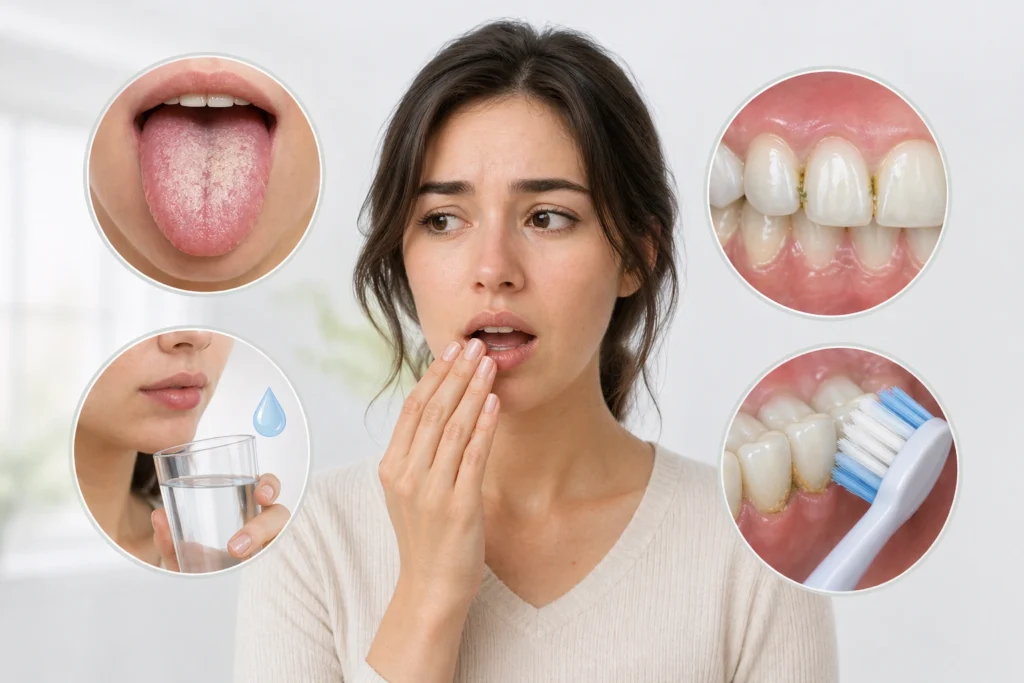
Because noticing that your breath still smells after brushing and actually figuring out which layer you are missing are two very different things. Once most people realize brushing did not fully solve it, their first reaction is usually not to think about the tongue, the spaces between the teeth, the back molar areas, or dry mouth. Instead, they immediately push the same action harder: harsher mouthwash, brushing longer, stronger mint sensation. But Mayo Clinic’s treatment suggestions for bad breath do not just stress brushing. They also stress brushing the tongue, cleaning between the teeth, and addressing dry mouth when needed. NHS places the tongue and the spaces between the teeth in the same important category as brushing itself.
In other words, when you keep going in circles with the feeling that “it still is not right after brushing,” what you usually need is not to make the same action stronger. You need to ask which layer you are actually missing. If the missing layer is the tongue, then intensifying tooth brushing will not truly solve it. If the missing layer is debris between the teeth, then more toothpaste foam does not mean those areas were cleaned. If the missing layer is dry mouth, then the fresh feeling will still drop off very quickly. What keeps many people stuck is not that they do not care. It is that they keep piling more force onto the most familiar action, instead of breaking the problem apart first. That way of thinking lines up closely with the guidance from Mayo Clinic, NHS, and Johns Hopkins.
How to Tell Which Layer Is Probably Causing the Odor if Your Breath Still Smells After Brushing
If your situation feels more like this, then the tongue layer is worth suspecting first: after brushing, your teeth themselves may not feel dirty, but the smell still seems to “hang in the back” of your mouth; it is more obvious in the morning; you have tongue coating, especially farther back; and brushing improves things briefly, but the problem comes back quickly. Mayo Clinic and Johns Hopkins both note that the tongue can collect bacteria, and that has a major effect on breath.
If what you feel is more like, “My teeth feel brushed, but something still feels wrong in the gaps or farther back,” then insufficient cleaning between the teeth is more worth suspecting. NHS clearly recommends using floss or interdental brushes every day because brushing alone does not replace that layer.
If what feels most familiar is, “It seems okay right after brushing, but very quickly my mouth gets dry, sticky, and not fresh again,” then you cannot focus only on brushing itself, because dry mouth reduces saliva, and saliva normally helps wash away the things that are more likely to create odor. Mayo Clinic lists dry mouth as one of the common causes of bad breath.
If the odor keeps staying there after brushing, and you also have gum bleeding, pain, mouth sores, tooth decay, periodontal discomfort, or long-term odor that never really goes away, then you should not treat it as just an everyday breath issue. Mayo Clinic notes that gum disease, tooth decay, and oral infections can also cause bad breath.
If You Already Suspect the Problem Is Not “I Did Not Brush,” but “I Missed a Layer,” What Products Are More Worth Prioritizing Next?
Once you start realizing that the problem is not simply whether you brushed, but which layer you keep failing to address completely, the next products worth prioritizing are usually not stronger toothpaste. They are tool-based and support-based products that more directly fill the gap. For this kind of “my mouth still does not feel fresh after brushing” pattern, what really matters is not piling on a heavier sense of freshness. It is actually reaching the areas you have not been treating properly.
If your breath still smells after brushing, the most useful next step is usually not to brush harder, but to target the layer you may have been missing. That is why the products below are the ones we would prioritize for this stage—they are more relevant if brushing alone is not giving you a truly clean, stable feeling.
Best for Tongue-Related Odor
A practical tool if the smell seems to linger even after brushing and your tongue feels coated or heavy.
Best for Debris Between Teeth
A better fit if brushing makes your teeth feel cleaner but the mouth still does not feel fully fresh.
Best for Hard-to-Reach Cleaning Support
A useful option if food or odor seems to stay around the back teeth or between teeth where brushing alone is not enough.
Best for Dry-Mouth-Related Instability
A more suitable choice if the freshness drops quickly and your mouth tends to feel dry or sticky soon after brushing.
The products above are the priority for this stage, and the related articles below are there if you want to better understand the cause behind them.
If You Want a More Complete Way to Solve Bad Breath, We Also Have a Full Guide
The focus of this article is to help you judge why your breath can still feel off even after brushing. But if you want a more complete solution to bad breath, we also have a full step-by-step guide that walks you through the main causes, the right order to address them, and what is most worth focusing on next. Once you can see the whole path more clearly, it becomes much easier to judge whether the missing layer for you is the tongue, the spaces between the teeth, dry mouth, or a deeper oral issue.
If Your Mouth Still Does Not Feel Fresh After Brushing, What You May Really Need Is Not Stronger Cleaning, but a More Complete Cleaning Path
The moment many people notice odor is still there after brushing, they instinctively assume they need “something stronger.” But for many people who keep running into this pattern, what is really missing is not intensity. It is the path. It is not that you have done nothing for your oral care. It is that you have kept strengthening the action you already know best, while never taking the layer where odor most easily hides and treating it separately. Mayo Clinic, NHS, and Johns Hopkins all point in the same direction: brushing absolutely matters, but the tongue, the spaces between the teeth, and dry mouth can all directly affect your breath too.
Once you stop asking, “Did I brush well enough?” and start asking, “Which layer am I actually missing?” things usually become much clearer. That does not mean the problem disappears immediately. It means you are no longer just repeating the same action again and again. You are finally dealing with the place where the odor has been staying. In many cases, real improvement does not come from a heavier surface-level fresh feeling. It comes from a more complete and more accurate cleaning and support path. That direction also matches the logic in the current Oralro bad-breath main page: do not rely only on surface treatment—find the place where the odor is really staying.
Affiliate Disclosure:
Some of the links on this page may be affiliate links, which means we may earn a small commission if you make a purchase through them, at no extra cost to you. We only recommend products that are relevant to the topic and that we believe may be genuinely useful to you.
Medical References:
National Institute of Dental and Craniofacial Research (NIDCR)
Mayo Clinic
NHS
Cleveland Clinic