How to Fix Bad Breath the Right Way?
You’ve probably tried to deal with bad breath more than once. You haven’t ignored it. In fact, you may already have your own way of managing it: brushing before going out, rinsing before talking to people, and keeping gum, mints, or breath spray close by. ManThat is why the first product layer in this page should not be freshening products.y times, those things really do help for a while. Your mouth feels fresher, you feel a little more relaxed, and talking to people becomes easier.
But the exhausting part is this: it rarely lasts. After a while, the same uncertainty comes back. You start paying attention to distance again, watching how other people react, and even catching yourself wondering after you speak: Does my breath smell right now?
That is what makes bad breath so draining. It is not always severe, but it slowly pulls you into a cycle of checking, adjusting, and trying again. You feel like you are already doing something about it, yet the problem never truly ends. The issue is not that you are doing nothing. It is that everything you are doing is fragmented. Brushing is one layer. Mouthwash is another. Gum or spray adds yet another layer. But none of these actions form a complete system.
So this page is not about how to temporarily cover bad breath. It is about something more important: why it keeps coming back even when you are trying, and how to deal with it in the right order so it becomes more stable over time.

The first thing to understand is this: bad breath usually does not appear suddenly. It develops gradually. Mayo Clinic also notes that bad breath can be linked to food debris, plaque buildup, gum issues, and bacteria on the tongue. That means the real problem is not simply whether you brush your teeth. The real problem is that you may only be dealing with the smell itself, instead of the reason it keeps forming. That is why so many people feel frustrated: you brush, you rinse, you pay more attention than before, and yet your mouth still does not feel fully clean or stable.
Why Your Bad Breath Never Seems Fully Solved
Many people automatically assume that bad breath simply means the mouth is not clean enough, so the solution must be brushing more often or using stronger mouthwash. It sounds reasonable, but it only deals with the surface. When your breath improves briefly after brushing, that does not necessarily mean the problem has been solved. Many times, it only means you refreshed the surface of your mouth while the real odor sources stayed exactly where they were.
One of the most commonly overlooked sources is the tongue, especially the back of it. Many people brush carefully but rarely make tongue cleaning part of a consistent routine. As a result, the teeth may feel clean while the tongue still carries a layer that keeps producing odor. That is why your mouth can still feel heavy, stale, or not fully fresh even after cleaning. This is not just in your head. The tongue itself can hold odor-causing bacteria.
Another common source is between the teeth, around the back molars, and along the gumline. You may be cleaning what you can see, but the places most likely to trap debris and keep producing odor are often the places you do not fully reach. For many people, recurring bad breath is not a sign that they do not brush. It is a sign that their cleaning structure is incomplete.
There is also another layer that many people underestimate: dry mouth. Think about your own pattern. Is it worse when you wake up? Worse after talking for a long time? Worse when your mouth feels dry or sticky? If that sounds familiar, then your problem is probably not just incomplete cleaning. Dryness may be amplifying it. Resources from the National Institute of Dental and Craniofacial Research (NIDCR) also make it clear that dry mouth can affect oral balance and make bad breath more noticeable. Saliva helps maintain balance in the mouth, and once the mouth stays dry for too long, the results of cleaning become much less stable.
In other words, bad breath is rarely caused by one single thing. It is usually several layers working together—tongue buildup, incomplete cleaning between the teeth, dry mouth, and a routine that is too fragmented to solve the problem at its source.
How to Actually Fix Bad Breath
If you really want to improve bad breath, you need to shift from temporary relief to a structured solution. You do not need to buy everything at once, and you do not need to make your routine complicated, but you do need to understand the right order.
Most people rely too heavily on quick-fresh products like gum, spray, mints, or strong mouthwash. These are not useless. They can help in the moment and make social situations feel easier. But the problem is not whether they work temporarily. The problem is that they only change how your breath feels right now, not why it keeps coming back.
So the first step is not to ban them completely. It is to stop treating them as your main solution.

What you usually need to fix first is not your toothpaste, but the structure of your cleaning. For most people with recurring bad breath, the two areas that matter most are the tongue and the spaces between the teeth. Those are the places most likely to keep producing odor, and they are also the easiest to ignore.
If you still feel unclean after brushing, or if the fresh feeling disappears quickly, the important question is not “Which toothpaste is stronger?” It is “Have I actually cleaned my tongue properly?” and “Have I consistently cleaned between my teeth and around the back areas that trap buildup?” That is where many people get stuck.This is also why sources like Mayo Clinic and NHS place tongue cleaning and cleaning between the teeth among the most important basic steps. You feel like you are already doing a lot, but the two layers that matter most have never really been completed.
That is why the first product layer at this stage should not be freshening products.It should be cleaning-structure products. In other words, the more useful place to start is with a tongue scraper, floss, interdental brushes, or a water flosser. A tongue scraper makes the most sense if your breath feels especially heavy in the morning or your mouth still feels thick after brushing. Floss and interdental brushes make sense if food gets trapped easily or the spaces between your teeth never feel fully clean. A water flosser can be especially helpful if you know you should clean between your teeth but struggle to do it consistently, or if your back teeth never feel fully reached.
For many people, the value of a water flosser is not just that it cleans more powerfully. It is that it makes a difficult habit easier to follow. What you really need is not a product that sounds more powerful, but a structure you can actually maintain. You need a structure you can actually maintain. And real improvement usually does not come from one “magic” product. It comes from finally covering the places your routine has been missing.
If your bad breath keeps returning even after brushing, the most useful next step is usually not to switch toothpaste again, but to strengthen the tongue and interdental layers. That is why the products below are the ones we would prioritize for this stage—they were selected to match the hidden areas most likely to be keeping the problem going, and they are the best place to start if you want a more targeted solution.
Best for Tongue Buildup
A direct way to remove odor-prone buildup from the tongue surface.
Best for Trapped Debris
A simple first step for food debris and plaque between the teeth.
Best for Tight Spaces and Gumline Areas
A more targeted option for spots floss may not clean as easily.
Best for Easier, More Complete Cleaning
A stronger and more convenient option for deeper daily cleaning.
The products above are the priority for this stage, and the related support pages below are there if you want to better understand the cause behind them.
If It Keeps Coming Back, Do Not Ignore the Dry-Mouth Layer
A lot of bad-breath content stops at cleaning, but for many people that is not where the problem ends. Some people are already cleaning more carefully than before, and yet the problem still does not feel stable. In that case, you usually have to look at the next layer: dry mouth.
Think about whether this sounds like you. Is it worse when you wake up? Worse after long conversations? Worse when you have not been drinking enough water? Worse when you feel stressed and your mouth gets dry? If so, then the cleaning you have already done is not necessarily useless. It is just not complete yet. The moment the mouth becomes too dry, the environment becomes easier for odor to build again. That is why some people feel like they are doing everything right, but the problem still keeps returning.
For this type of situation, the goal is no longer just removing odor. It is making the oral environment more stable. That means paying attention to hydration, noticing whether you breathe through your mouth at night, using sugar-free gum after meals to stimulate saliva, and avoiding products that are too harsh and make dryness worse. If dry mouth is clearly part of your pattern, then you should not keep putting all your hope into “another cleaning product.” You need to add a dry-mouth support layer. Once you do, the results of your earlier cleaning steps usually become much more stable. For this type of reader, the real value is not cleaning again. It is keeping the mouth from returning so quickly to an odor-prone condition.
If dry mouth is part of what keeps your bad breath coming back, the most useful next step is usually not to clean harder, but to support the moisture layer that helps your mouth stay more stable. That is why the products below are the ones we would prioritize for this stage—they were selected for you whose breath gets worse after sleep, long conversations, or whenever the mouth starts to feel dry.
Best for Everyday Moisture Support
A simple way to help stimulate saliva and make the mouth feel less dry throughout the day.
Best for Quick Dry-Mouth Relief
A practical option when your mouth feels dry quickly and you want fast, targeted moisture support.
Best for Gentler Daily Support
A better fit for you who need ongoing support without using products that make the mouth feel even drier.
The products above are the priority for this stage, and the related support pages below are there if you want to better understand the cause behind them.
If You Have Already Improved the Basics, Then Move Into Longer-Term Support
This step matters because it determines whether the second half of the page feels natural or forced. Not everyone with bad breath needs higher-value products right away. But if you have already improved the basic layers and the problem still keeps returning, then deeper support starts to make more sense.
Who is this layer really for? Usually, it fits people whose bad breath has lasted for a long time—people who are not ignoring it, and may already be doing more than the average person. At that stage, you are no longer just trying to feel fresher for the next hour. You are trying to improve stability over time. That is where products like oral probiotics become much more relevant.
These products are not there to replace brushing, tongue cleaning, interdental cleaning, or dry-mouth support, and they are not there to promise a cure. They make more sense as a deeper support layer for you who have already improved the basics but still want better long-term stability. If you later want to expand into higher-value content on your site, this is also the layer that naturally connects to more advanced oral-support or long-term maintenance products.
For you who have been struggling with recurring bad breath for a long time, this part often feels more convincing because it speaks to a real need. It is no longer about instant freshness. It is about reducing how often the problem comes back.
Where You Should Actually Start
At this point, you may be wondering whether you need to do everything at once. The answer is no. The most realistic and sustainable way to handle this is not to pile on every possible step. It is to add the missing layers in the right order.
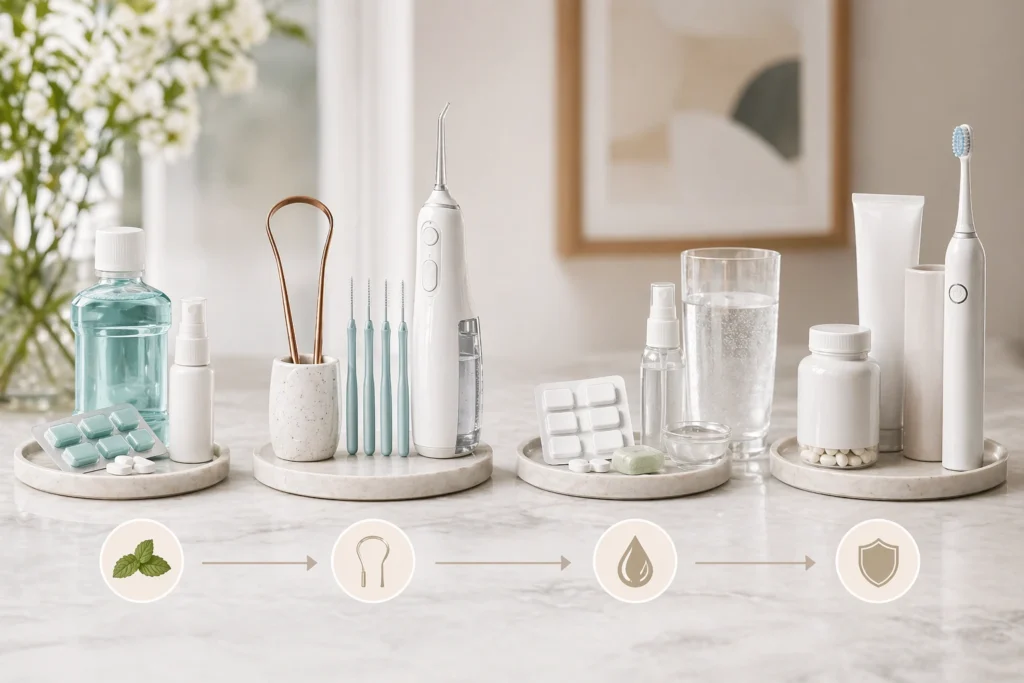
The first thing you need to do is figure out where you are right now. If you mainly rely on spray, gum, mints, or strong mouthwash, then you are still mostly in the masking layer. In that case, the important move is not to buy more of the same. It is to shift your attention toward the sources that keep producing odor. The next priority is usually the tongue and the spaces between the teeth, because that is where many recurring cases really begin. Once those layers are more complete, then you look at whether dry mouth is also making the problem worse. If it is, you add that support too. Only after those layers are in place does it make sense to decide whether you need deeper long-term support.
That is what makes a more useful solution different from a random list of products. It should not just throw products at you. It should help you understand where you are, what layer you are missing, and what your next useful step actually is. When a page helps you judge your own situation more clearly, the product recommendations feel much more natural and much easier to trust.
If your bad breath keeps coming back even after you have already improved the basics, the most useful next step is usually not to repeat the same surface-level fixes, but to add a deeper support layer that is better matched to a long-term recurring pattern. That is why the products below are the ones we would prioritize for this stage—they were selected for you who are no longer looking for a short burst of freshness, but for something that may help improve long-term stability.
Best for Long-Term Oral Balance
A more targeted support option for you who want to improve oral stability over time instead of relying only on short-term freshening products.
Best for a More Complete Routine
A better fit for you who want to support multiple layers of their routine instead of depending on a single product type.
Best for Recurring Bad-Breath Patterns
A more structured option for you who want a curated group of products matched to an ongoing, repeating pattern rather than a one-time fix.
The products above are the priority for this stage, and the related support pages below are there if you want to better understand the cause behind them.
When You Should Not Rely on Products Alone
This is a solution page, not a fear-based page, but boundaries still matter. If your bad breath has lasted for a long time and still does not improve, or if it comes with obvious gum bleeding, gum disease, mouth pain, ulcers, severe dryness, or a persistent bad taste, then it is not a good idea to put all your hope into “one more product.” NHS also advises seeking professional help when bad breath continues despite proper oral care.Products are useful for improving your routine, filling gaps, and making your results more stable. But if the issue has already become long-term or comes with other clear oral symptoms, then a dental check-up is often the faster and more reliable way to figure out what is really going on.
That does not mean the product path above has no value. It means you should not stay stuck in the cycle of wondering whether one more item will finally solve everything when the real issue may need professional attention.
Bad Breath Is Not Solved by One Product, but by the Right Order
If you are still asking yourself how to truly fix bad breath, the answer is actually not that complicated. The real problem is usually not that you are doing too little. It is that you are dealing with it in an incomplete way. It is not about stacking more short-term freshening products, brushing more often, or chasing whatever product looks popular at the moment. In many cases, the problem is not that you are ignoring it. It is that you are still stuck in the temporary-masking layer, so the smell seems to improve for a while and then comes back again.
What works better is to break the problem down in the right order. First, recognize whether you are mostly relying on gum, spray, or strong mouthwash to get through the day. Then complete the two layers most people miss: the tongue and the spaces between the teeth. Next, figure out whether dryness is quietly making the problem worse. Finally, if you have already improved those layers and the issue still keeps returning, move into deeper long-term support.
When you approach it this way, bad breath stops being something you react to every single day. It becomes something you understand more clearly, manage more steadily, and gradually bring under control. You are no longer stuck in endless damage control. You are building a more complete, more stable, and more intentional solution path.
Which Type Are You? Start With the Right Layer
1. You still feel unclean even after brushing, especially in the morning
If your main feeling is that you have already brushed your teeth, but your mouth still feels heavy, thick, or not fully fresh—especially when you wake up—then the missing layer is usually not “more brushing.” It is usually your tongue.
A lot of people clean their teeth carefully but never really deal with tongue buildup, especially toward the back of the tongue. That is why the mouth can still feel stale even when the teeth themselves feel clean. For this type of bad breath, adding more short-term freshening products usually does very little. What makes more sense is to deal directly with the surface that is still holding odor.
For this layer, the best place to start is tongue-focused cleaning and light daily support. That can include a tongue scraper, a gentle supportive mouthwash, and other tongue-cleaning tools that help remove buildup more consistently instead of just masking the smell for a short time.
2. Food gets stuck easily, and your back teeth, gumline, or the spaces between your teeth never feel fully clean
If your most familiar feeling is not “my whole mouth smells all the time,” but “something still feels stuck somewhere,” especially around the back teeth, between the teeth, or close to the gumline, then your issue is usually not a lack of effort. It is an incomplete cleaning structure.
You may already be brushing carefully, but brushing alone often misses the exact places where food debris and plaque tend to stay behind. That is why this type of bad breath often feels stubborn. It is not that nothing is being done—it is that the areas most likely to keep producing odor are not being fully reached on a consistent basis.
For this layer, the priority should be tools that help you clean those hidden areas properly. That usually means floss, interdental brushes, and water flossers. If you know you should clean between your teeth but struggle to do it consistently, this is exactly where a water flosser becomes much more valuable.
3. Your breath gets worse when your mouth feels dry, after sleep, or after talking for a long time
If your bad breath becomes more obvious when you wake up, after long conversations, or whenever your mouth feels dry, then dryness is likely doing more damage than you realize. In this case, the problem is not only about cleaning. It is also about the fact that your oral environment becomes easier to destabilize when there is not enough moisture.
This is why some people feel that they clean well, but the problem still comes back quickly. The issue is not necessarily that the cleaning did nothing. It is that the mouth returns too easily to the kind of environment where odor builds again.
For this layer, what you need most is not stronger and stronger cleaning, but support that helps the mouth stay more comfortable and more stable. That can include sugar-free gum, dry-mouth sprays, moisture-support products, and gentler daily-care options that do not make dryness worse.
4. You have already improved a lot of the basics, but the problem still keeps coming back
If the part that sounds most familiar to you is, “I’ve already done a lot, so why does it still come back?”, then you are more likely dealing with a long-term recurring pattern. This type of reader is usually not ignoring the problem. In many cases, they are already doing more than the average person. They brush, they rinse, they pay attention, and yet the problem still returns.
At this stage, you are no longer looking for something that simply makes your mouth feel fresher for the next hour. You are looking for something that may help improve long-term stability. That is why this is the right place to introduce deeper support rather than just repeating the same basic tools again.
For this layer, oral probiotics and other longer-term oral-support products make much more sense. The goal here is not to promise a miracle result. It is to offer a more advanced support layer for you who are no longer beginners in dealing with this problem.
If You Need More Than a Surface-Level Fix
If you have made it this far and already understand that bad breath is not something you can keep under control long term with surface-level fixes alone, then the next step worth taking seriously is not just repeating the same basic actions again, but beginning to look at a deeper layer of long-term support. For some you dealing with a recurring pattern, the real goal is no longer just whether there is odor today, but whether the oral environment, daily condition, and overall stability can gradually move in a direction that is less likely to keep falling out of balance.
That is why, once you have already worked on the basic layers—your tongue, interdental cleaning, and dry-mouth support—products like oral probiotics, long-term oral-support products, and even support options that lean more toward internal balance can start to make more sense at this stage. They are not there to replace the basic work you have already done. They are there to give you who have already done a lot, but still want to move the problem toward greater stability, a more advanced next step. At that point, you are no longer just patching the problem for today—you are trying to reduce how often it keeps coming back.
Affiliate Disclosure:
Some of the links on this page may be affiliate links, which means we may earn a small commission if you make a purchase through them, at no extra cost to you. We only recommend products that are relevant to the topic and that we believe may be genuinely useful to you.
Based on trusted health sources:
- Mayo Clinic
- NHS
- National Institute of Dental and Craniofacial Research (NIDCR)
- Johns Hopkins Medicine