Best Dry Mouth Products for Bad Breath
What You Really Need to Compare Is Not Which One Feels Most Like a “Quick Fix,” but Which Type Fits You Best
When people search for Best Dry Mouth Products for Bad Breath, the thought is usually very direct: if your mouth feels dry and your breath feels worse, then you should find something that can “add moisture” or make things feel a little more comfortable first. But what you are really trying to solve is usually not whether you can get a little short-term relief. What you really want to know is why your mouth still becomes dry, sticky, rough, or empty-feeling so easily even though you are already brushing, rinsing, and drinking water—especially when you first wake up, after talking for a long time, after staying up late, or after spending too long in air-conditioned spaces, when bad breath seems to get heavier along with the dryness.
This is also where dry-mouth products are easiest to buy the wrong way. It is very natural to look for something that can make you feel better right away, because the discomfort is obvious in the moment, and your instinct is to push down that dry, rough, sticky feeling first. But once you start using products more regularly, you usually begin to realize that the real issue is not simply whether the product feels moisturizing enough. The issue is whether it matches the layer of support you actually need right now. For some people, the key is whether it helps during the day. For others, the real problem is whether nights and mornings can feel less miserable. And for some people, what they truly need is a gentler, more sustainable daily route rather than something that only helps in the worst moments.
Mayo Clinic already includes dry mouth as one possible cause of bad breath. Cleveland Clinic also notes that when saliva is reduced, odor and bacterial buildup can become easier to notice. And in the American Dental Association’s general patient-facing guidance, the focus is consistently on maintaining an oral environment that fits you better over time, not just chasing one action that feels immediately effective. In other words, dry-mouth products are not just temporary tools that “make things feel wetter for a moment.” For many people, this is one of the layers they have never really sorted out properly.
So this article is not going to use a scattered “recommend a bunch of products” approach, and it is not just going to place a few names on the page. What matters more is helping you see one thing clearly: Best Dry Mouth Products for Bad Breath is not one fixed answer. It is a matching problem. What you really need to compare is not which one feels most like an emergency fix, but which type of product comes closest to the layer you most want to solve right now.

Why Some Dry-Mouth Products Feel Helpful in the Moment, but Still Do Not Really Stay in Your Routine
You have probably had this experience already. The first time you use a dry-mouth product, your mouth really does feel a little better. The rough, sticky dryness eases up a bit, and you instinctively feel like you may have finally found the right direction. But after using it for several days, you may gradually realize that some products only give short-lived relief and then the problem comes back soon afterward. Some may feel useful, but you do not actually want to carry them around and keep using them every day. And some look like serious dry-mouth solutions, but they simply do not fit the stage you are in right now, so in the end they still get pushed aside.
That is why so many people have already bought dry-mouth products and still have not really handled the bad-breath layer connected to dryness. The issue is not always that the product does nothing. Often, the problem is that the type you bought did not match the situation in which your discomfort shows up most often. Mayo Clinic points out that dry mouth can affect the mouth’s self-cleaning ability and make odor easier to notice. Cleveland Clinic, when discussing dry mouth, also places more emphasis on finding a type of support that actually suits long-term use rather than repeatedly relying on brief relief to get through the day. In other words, what you really need to solve is not, “Did I buy something that can make me feel better for a moment?” It is, “Did I find a product type that can help me stay more stable during the part of the day when I most often fall apart?”
So instead of continuing to chase whatever seems most popular, it makes more sense to change the logic first: figure out when you most often get dry, uncomfortable, and noticeably stale, and then compare the types of products that fit that situation best. Once you do that, your choices become much clearer, and it starts to feel more like solving the real problem rather than buying another product that only looks good on day one.
If You Get Dry More Easily During the Day, Which Type of Product Should You Compare First?
If your problem feels more like something that keeps showing up during the day—for example, after talking for a while, sitting through meetings, driving, or spending too long in air-conditioned rooms, when your mouth starts to feel rough and sticky and your breath becomes less stable—then what usually deserves your attention first is not a product that only makes sense before bed. What makes more sense is something closer to portable moisture support.
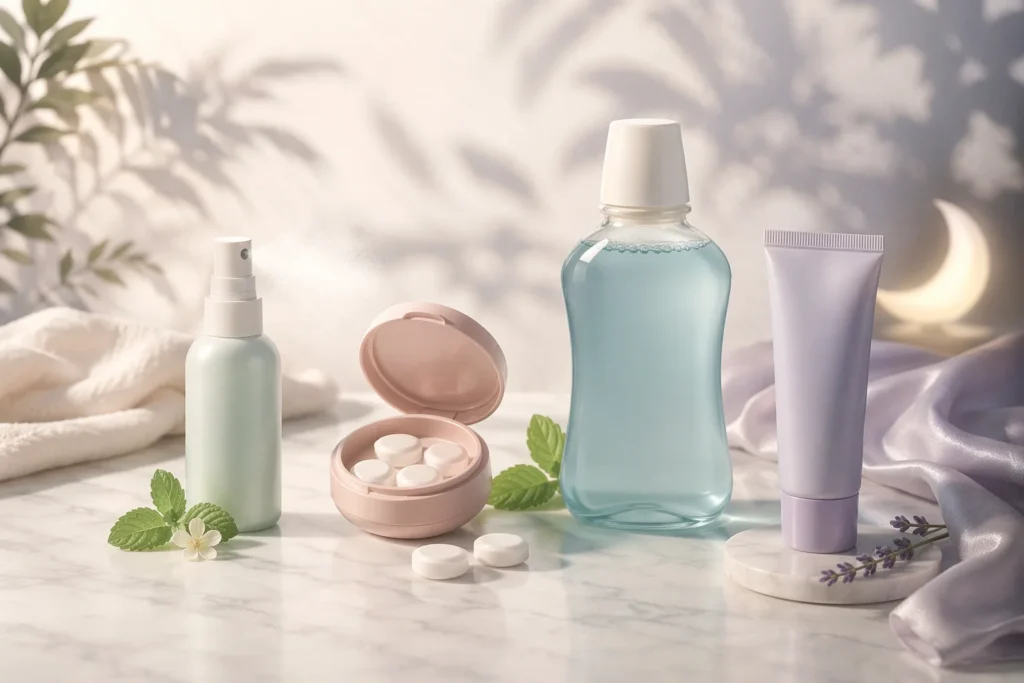
This kind of direction works better for people who need to add a little support throughout the day and keep their mouth from gradually slipping into a worse state. Products like dry-mouth oral sprays or xylitol lozenges / gum tend to fit the kind of situation where you need something you can use easily, quickly, and repeatedly. What you need right now is not to fully solve the problem in one move. You need to stabilize the kind of discomfort and bad-breath fluctuation that keeps showing up during the day. For you, what really matters is whether you are willing to carry it with you and whether it feels natural to use when you need it—not whether it feels especially “medical” the moment you try it.
If you are reading this and already realizing that you sound more like the type who keeps getting dry throughout the day, feels worse the more you talk, and notices your breath becoming less stable as the dryness builds, then what is most worth looking at next is not something large that just sits at home. It is the more portable, easy-to-use types that let you add a little support when you actually need it, because those fit the part of the day where your problem shows up most often.
If most of your frustration happens during the day, and you have already noticed that this is not just an occasional dry spell but something that happens repeatedly whenever you get busy or talk more, then the categories below usually deserve more of your attention because they fit those small but frequent daytime moments better rather than only serving as occasional rescue products.
If your skin tends to feel dry throughout the day, you might want to prioritize these products, as they are better suited for providing daytime hydration and on-the-go relief.
If you’ve noticed that your bad breath always seems to occur alongside dry mouth, the article below is a great resource to help you better understand whether dry mouth might be one of the underlying causes.
If Nights and Mornings Are When It Feels Worst, You Should Be Looking at a Different Type of Product
But not everyone’s dry mouth behaves like a daytime problem. For some people, the most difficult moments are before bed, in the middle of the night, or first thing in the morning. You can clearly feel that your mouth is dry, empty, sticky, and uncomfortable, and sometimes the moment you open your mouth, you already know the situation is off. For this kind of pattern, what you really need to compare is not whether a product is easy to carry. What matters more is whether it can help stabilize the night and morning period a little better. That is when products like a dry-mouth rinse or an overnight dry-mouth gel often become more worth prioritizing, because they lean more toward sustained support.
This type of product makes more sense for people whose real issue is not an occasional dry spell during the day, but a concentrated pattern of discomfort around sleep and waking. Both Mayo Clinic and Cleveland Clinic note that dry mouth can make the oral environment more likely to lose balance, and mornings are already the time when many people feel their breath is at its worst. If your problem is showing up mainly around sleep, then simply relying on a little daytime support usually is not enough. For you, the real issue is no longer emergency relief. It is making the stretch of time that falls apart most easily feel less miserable.
So if you already feel that you sound more like the type whose nights and mornings are especially bad, then what is more worth comparing is not the most portable route, but the products that lean more toward sustained support, overnight compatibility, and better carryover into the morning. Because for you, the real problem is not that your mouth feels equally dry all day. It is that one particular time window feels especially concentrated and especially difficult.
If the time that hurts most is always the evening and the morning, and you already know clearly that this is not a temporary one-off but something that comes back every day, then the categories below usually deserve more of your attention, because they are better aligned with overnight support and sustained comfort rather than just short-lived relief.
If you fall into the category where symptoms are particularly noticeable at night and in the morning, the products listed below are worth considering over standard portable models, as they better address your current needs for sustained support and nighttime comfort.
If you’re starting to suspect that the problem isn’t just “a slightly dry mouth,” but is actually related to morning bad breath and recurring issues, the article below can help you understand why the problem keeps coming back.
How You Should Really Compare These Dry-Mouth Products Instead of Just Looking for the One That Seems Most “Effective”
If you connect the logic above, you start to see something much more clearly: what is really worth comparing under Best Dry Mouth Products for Bad Breath is never “which one looks the most effective,” but “which one comes closest to the point where I am stuck right now.” You are not looking for one dry-mouth product that everyone agrees is the best. You are looking for the type that fits your current oral condition and the time of day when your problem shows up most often.
If you are more the type whose mouth keeps drying out during the day, and gets worse the longer you talk, then you should prioritize portable, easy-to-use daytime-support options.
If you are more the type whose nights and mornings are the hardest part, then you should prioritize longer-lasting, overnight-oriented categories.
If you are especially sensitive to stronger sensations or simply do not like products that feel too intense, then gentler, lower-irritation directions should also move closer to the front.
And if you have already bought products before but always end up feeling, “It is not that they do nothing, they just never really stay with me,” then you should compare from the angle of use scenario, not advertising language.
In other words, what you really need to solve is not, “Which one looks the most like something that can rescue me right now?” It is, “Which type fits the stretch of time where I most need to become more stable?” Once that matching logic becomes clear, your next choices become much simpler, and you are much more likely to end up with the type you can actually keep.
Dry-Mouth Products Matter, but If You Want a More Complete Way to Handle Bad Breath, You Cannot Stop at Dry Mouth Alone
Dry-mouth products are definitely important, but they are not necessarily the whole answer. In the ADA’s general way of thinking about oral care, the focus is not simply whether you can add a little moisture. It is whether the overall oral environment is something you can maintain more easily over time. When Mayo Clinic discusses bad breath, it also does not place all the emphasis on a single product. It looks at dry mouth, tongue bacteria, cleaning habits, and the overall oral condition together. In other words, once you handle the dry-mouth layer more effectively, things may certainly become easier—but if you still have tongue buildup, trapped debris between teeth, lingering odor after brushing, or an overall care sequence that does not really fit your situation, then the improvement you feel may still remain limited.
So the more realistic approach is not to place all your hope on one dry-mouth product. It is to use the type that fits you better to first stabilize the layer where “the moment my mouth dries out, my breath gets worse,” and then step back and look at which parts of your overall oral-care path still deserve support. That way, you are less likely to stay stuck in the cycle of thinking, “I already bought these things, so why does it still not feel fully right?”
If you’d rather not just keep switching products but want to understand the entire process of addressing bad breath, this comprehensive guide below is a better fit for you—keep reading.
Best Dry Mouth Products for Bad Breath Is Not One Universal Answer, but the Type That Fits You Better
When many people search for Best Dry Mouth Products for Bad Breath, what they want is the most direct and standard answer possible. But the answer that usually comes closer to real-life experience is this: the best option for you is not necessarily the one that feels most like an emergency fix, and not necessarily the one that looks the most “professional.” It is the type that fits your current oral condition, the part of the day when the problem shows up most often, and the way you actually live with it.
If daytime dryness is what bothers you most, then start with portable, easy-to-use daytime support.
If nights and mornings are what feel the worst, then start with longer-lasting, overnight-oriented categories.
If stronger sensations make you uncomfortable, then gentler, lower-irritation directions should move forward first.
Once that matching logic is clear, your next choices become much simpler, and you are much more likely to actually stabilize the bad-breath problem that gets worse whenever your mouth dries out.
Affiliate Disclosure:
Some of the links on this page may be affiliate links, which means we may earn a small commission if you make a purchase through them, at no extra cost to you. We only recommend products that are relevant to the topic and that we believe may be genuinely useful to you.
Medical References:
Mayo Clinic
Cleveland Clinic
American Dental Association (ADA)
Johns Hopkins Medicine