How to Make Your Teeth Look Whiter and Cleaner
What you want, most of the time, is not that exaggerated, unreal kind of “extreme white,” and it is not a smile that looks obviously overtreated. What you usually want is simply a result that looks cleaner, brighter, and more polished. You want to look in the mirror and see teeth that look fresher and more refined, without that yellow, dull, or slightly aged look. You want your smile to feel easier to show, and you want your whole face to look more awake and put together when you do.
Once the look of your teeth improves, the change usually does not stop at your teeth. You stop holding your smile back in photos. You feel more relaxed when speaking up close. After you have already done your hair, makeup, outfit, or daily self-care, your teeth no longer hold the rest of your look back. A lot of the time, people may not be able to tell exactly what changed, but they do notice that you look fresher, more polished, and more put together.
That is exactly why teeth whitening stays so appealing. It is not only a color issue. It is an appearance issue. What you are really after is not “not too bad.” It is “better than this.” It is not “good enough.” It is “this finally looks how I want it to look.” What keeps bothering many people is not that their teeth have some major problem. It is that feeling of clearly putting in effort and still not reaching the version of their smile they actually want.
A lot of people get stuck in the same place. You may already brush every day and you may not be careless about your oral appearance at all, yet the result still sits in that in-between zone: your teeth do not look dirty, but they do not look bright enough; they are not especially yellow, but they do not look clean enough; the overall impression is not bad, but it still lacks that extra sense of freshness and polish. At that point, what you need is no longer basic cleaning. What you need is a clearer upgrade path for making your teeth look whiter, cleaner, and more attractive.
Teeth Looking Whiter Is Not Just About a Lighter Shade. It Is About Looking Cleaner, Fresher, and More Refined.
When most people think about whitening, they think about shade first. But what actually makes teeth look good is rarely just color depth. It is whether they look fresh, clean, evenly toned, lightly polished, and visually balanced with the rest of your face when you smile.
You have probably seen this difference yourself. Some people do not have dramatically white teeth, but their teeth still look attractive because the surface looks clean, the tone looks even, and the whole smile feels fresh and polished. Other people may not have especially yellow teeth, yet their teeth still look grayish, dull, or not fully clean, and their smile seems to lose a little life because of it. That difference is often not just about shade. It is about whether whiteness, cleanliness, brightness, and neatness are all working together.
That is why the goal is not some harsh, unrealistic whitening result. The better goal is a more natural, more flattering, more wearable kind of improvement: teeth that look more even in tone, cleaner on the surface, brighter overall, and more polished when you smile. That kind of change does not feel overdone. It just makes your whole appearance feel more refined.

Why Do Your Teeth Still Not Look White Enough Even If You Brush Every Day?
This is a very common experience. Brushing mainly brings your teeth back to a basic clean state. But “basically clean” and “visibly whiter, cleaner, and more polished” are not the same thing. Many people feel that they are already brushing carefully, yet their teeth still do not look noticeably better. Usually, that does not mean they are doing nothing. It means they are maintaining a baseline rather than actively improving appearance.
Once your goal changes from “not dirty” to “whiter, brighter, cleaner-looking teeth,” brushing alone often stops being enough. You start noticing whether your teeth look dull in photos, whether they look tired at close distance, and whether your smile still feels like it is missing a little polish. At that point, the old routine that only kept things from getting worse no longer matches what you want now.
And everyday habits can quietly keep pulling appearance down. Coffee, tea, red wine, darker foods, smoking, relying only on a regular toothpaste, never separating stain removal from brightening, or doing a little whitening without following through with maintenance can all add up. Any one of those may not seem dramatic on its own, but together they can keep your teeth stuck in that “fine, but not really where I want them” zone.
As institutions like Mayo Clinic continue to emphasize, brushing twice a day for about two minutes each time still matters, and cleaning between your teeth daily matters too. That kind of foundation is important, but foundation alone does not automatically create a visibly upgraded smile.
What Makes Teeth Look Less White and Less Clean?
Usually, it is not one single thing. Most of the time, it is a stack of smaller factors that make your teeth look less fresh, less bright, and less polished than they could.
One of the most common factors is surface staining. If you regularly drink coffee, tea, or other dark beverages, or if your diet frequently includes deeper-colored foods, the surface of your teeth is more likely to pick up that slightly yellow, gray, dull, or tired-looking cast. Even if you brush every day, those lighter surface stains are not always fully removed by basic cleaning. That is why your teeth can end up looking older or duller than you expected. Public health guidance like NHS materials also directly lists coffee, tea, red wine, and smoking among common staining sources.
A second factor is staying in a basic-care routine for too long. Many people do brush, but they use an ordinary toothpaste, ordinary brushing, and never separate stain removal, brightening, stronger whitening, and maintenance into different steps. That does not mean they are neglecting their teeth. It just means they are mostly holding things at “not too bad,” which is very different from actively making the smile look better. Even guidance from organizations like ADA separates whitening-supporting products from ordinary cleaning products because they do not all serve the same purpose.
A third factor is not matching product type to need. If you want your teeth to look whiter but still choose products with the mindset that “toothpaste is toothpaste,” you may end up with basic cleaning but no real stain-focus, no meaningful brightening support, and no real maintenance strategy. If the products are not layered, the result will not feel layered either.
A fourth factor is stopping too early. A lot of people do a little whitening, see a small improvement, and then stop. Short-term, something may improve. But without maintenance, the look often slides back down. Good-looking teeth usually come less from one intense burst of effort and more from a longer rhythm that actually supports the result.
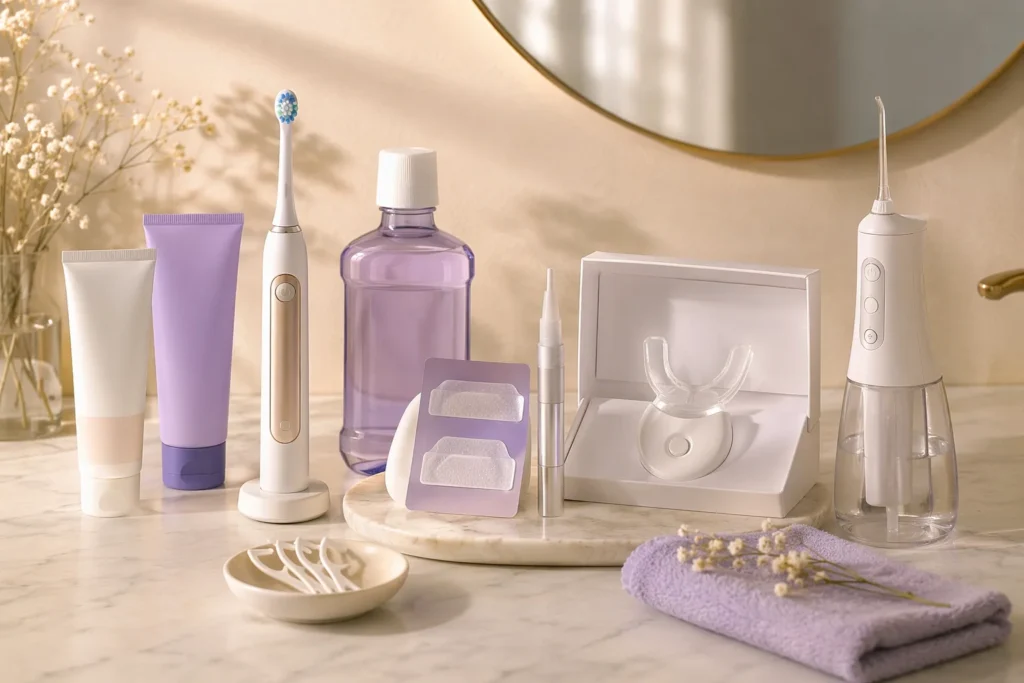
What Kinds of Products Are Part of a Teeth Whitening Routine?
Category 1: Everyday Brightening Toothpastes
If your teeth are not especially yellow and do not have heavy visible staining, but you still feel they look a little flat, dull, or not quite fresh enough in the mirror, then what you are missing is usually not strong whitening. It is a basic brightening layer that fits daily use. A lot of people feel they already brush, so their teeth should look better than they do. The real issue is often that they never moved beyond a standard cleaning routine.
If your main goal right now is simply to make your teeth look fresher and more put together, start with the toothpaste direction that supports that lighter, cleaner appearance first rather than jumping straight to aggressive whitening.
If what you notice most is a slight yellow, gray, or tired-looking cast on the tooth surface, then a surface-stain brightening direction makes more sense as your first step.
If you worry about sensitivity but still do not want to stay in the regular toothpaste category forever, then starting with a gentler brightening path usually makes more sense.
Category 2: Stain-Removal Toothpastes
If you drink coffee or tea often, or you can already see that your teeth tend to look slightly yellow, gray, or dull, then what you need is usually not “whitening” in the broadest sense first. You need to take care of the surface look that is dragging everything down. A lot of people whose teeth look old, dark, or tired in the mirror do not necessarily have deeply discolored teeth. Their surface staining has just never been handled in the right way. At this stage, the priority is not making teeth dramatically whiter overnight. It is removing that “not truly clean” look first.
If coffee and tea are the biggest visible staining habits in your routine, then it makes more sense to go straight to a coffee-and-tea stain-focused direction.
If you want stain removal but do not want to lean too hard into a stronger abrasive feeling, then starting with a gentler stain-removal path is usually the better fit.
Category 3: Functional Electric Toothbrushes
If you have been brushing for years and you are not careless about it, but the overall look of your teeth still has not changed much, then the issue may not be your toothpaste at all. It may be the cleaning method itself. A lot of people look like they are brushing regularly, but in practice they are mostly just completing the action without ever really improving surface neatness, edge clarity, or that cleaner, more polished look. At that point, the value of an electric toothbrush is not only convenience. It can help raise the consistency and effectiveness of cleaning enough to actually change how the teeth look.
If what you notice most is that the surface still does not look clean enough, and your teeth still seem a little old or dull after brushing, then start with a stain-removal cleaning direction. That is usually the better first move for making the tooth surface look more pulled together.
If what matters more to you is whether your teeth look neater, cleaner, and sharper after every brush, then a rotating-cleaning direction often makes more sense. That is usually better for people who want overall cleaning efficiency and visual neatness to improve together.
If you’re tired of worrying about the specific features of electric toothbrushes, this practical all-in-one model is the perfect choice for you. It’s ideal for those who don’t want to fuss over individual functions like whitening, polishing, or daily cleaning—a single toothbrush can meet all your oral care needs.
Category 4: Brightening Mouthwashes
A lot of people underestimate this layer, but it belongs on a main page like this. Some people are not failing because they never tried whitening. Their real problem is that the result does not stay stable. Things look fine right after brushing, but by the middle of the day, after drinks, or by evening, their teeth and mouth no longer look or feel as fresh. In that case, a brightening mouthwash is not meant to replace brushing. Its value is that it helps complete the routine and supports a cleaner-looking result through the day.
If comfort matters most to you and you do not want a harsh-feeling rinse, then an alcohol-free brightening direction is the better first look.
If your goal is lighter routine support rather than a dramatic shift, then a daily-brightening direction usually makes more sense.
If you have very clear staining habits and want a rinse that supports maintenance more directly, then a stain-control direction is usually the better fit.
Category 5: More Visible Whitening Products
If your goal is no longer “a little cleaner is enough,” but a smile that clearly looks brighter, whiter, and more camera-ready, then sooner or later you will move into this layer. A lot of people spend too long using only basic products and then wonder why the result never really changes. Usually that is not because those products do nothing. It is because the goal has changed. What you want is no longer a mild improvement. You want something more visible and more direct.
If you want the most obvious, easiest-to-understand visible whitening starting point, then strips are usually the first place to look.
If you prefer something lighter and more flexible, then a daily whitening pen often fits better as a first visible-whitening step.
If you are ready to build a fuller whitening routine rather than just testing one small step, then an at-home whitening kit is usually the more suitable direction.
If you want a tray-based route with a more structured home-use system, then a whitening tray direction usually makes more sense.
Category 6: Supporting Cleaning Tools
These products are not the ones directly responsible for making teeth whiter, but they do affect whether the whole smile looks clean enough, neat enough, and complete enough. A lot of the time, tooth color has improved somewhat, but the whole result still looks slightly unfinished. The problem is not always the white level itself. Sometimes it is that overall cleaning quality is still not high enough. If the spaces between teeth, the edges, and the harder-to-reach areas are not handled well over time, the whole mouth can still look a little less fresh and a little less polished.
That is why this layer is really about completing the overall look. You may not be missing a “stronger” whitening product at all. You may simply have ignored the areas around the teeth that make the whole smile feel fully clean. Once those details are handled more completely, the whole mouth usually looks neater and cleaner, and the brightening you already achieved is easier to hold up visually.
If you want a fuller, more stable daily-cleaning routine, something that feels more like a complete system, then a countertop water flosser is often the better place to start.
If convenience matters more and you want something easier to use often, then a cordless water flosser direction usually fits better.
If you need a very easy starting point that also feels easier to stick with long term, then floss picks are often the simplest first move.
If you already care about overall finishing details and want cleaner-looking spaces and edges, then interdental cleaning tools usually make the most sense.
The Appearance Improvements That Matter Most Usually Happen in Stages
If you want your teeth to look whiter and cleaner, you do not need to chase the strongest, fastest, most aggressive change right away. A better approach is usually to recognize which stage looks most like you now and then upgrade in layers.
Stage 1: Basic Clean-and-Bright
If your teeth are not especially yellow and you do not have strong visible staining, but you always feel they lack a little brightness, freshness, or neatness in the mirror, then you are probably still at the “basic care is barely enough” stage. The most common feeling here is not that your teeth look bad. It is that they look acceptable, but never quite as good as you want. The surface may not look dirty, yet the overall impression still lacks that clean, lively, polished quality.
At this stage, the smartest move is usually not strong whitening. It is getting the overall baseline looking cleaner and more put together first. When this layer starts working properly, many people see a change that feels immediate even if it is not dramatic: teeth do not suddenly turn very white, but they do start looking clearer, fresher, and better prepared for the next step.
Stage 2: Stain-Lifting and Brightening
If coffee, tea, or a constant yellow-gray dullness is part of what you notice most, then you are probably in the stage where surface appearance keeps being dragged down. You may not be neglecting your teeth at all. Your enamel just keeps getting visually weighed down by everyday staining, so in the mirror your smile never looks quite as bright or as alive as you want.
The goal here is not extreme whitening. The goal is to press down the surface factors that make the smile look old, tired, or dull. When this step is done better, teeth often move from looking muted and slightly gray to looking cleaner, brighter, and much easier on the eye. The shift is not always dramatic, but it is often one of the most satisfying.
Stage 3: Clearly Visible Whitening
If your basic cleaning is already decent and your teeth do not look obviously bad, but you still want a smile that looks noticeably brighter, whiter, and more refined, then you are probably already in the stage where you want visible change. At that point, brushing and mild brightening usually stop feeling like enough because your goal is no longer “clean enough.” Your goal is real visual lift.
This stage fits people who already know they want more than a subtle improvement. Once you reach this point, product choice should stop sitting in the “maintenance only” category and move toward more direct visible-whitening support.
Stage 4: Long-Lasting Polish
If you have already done some whitening and clearly liked how your teeth looked afterward, but that result never seems to hold for long, then you are probably stuck in the “improved before, but could not keep it” stage. A lot of people are disappointed with whitening not because nothing worked, but because they never built anything that maintained the result. So the look fades, and it starts to feel like they are beginning again every time.
The value of this stage is simple: it is not about starting over. It is about holding onto the brightness, cleanliness, and polish you already created. Long-term attractive teeth usually depend less on one intense push and more on whether you have a stable, gentle maintenance path you can actually keep doing.
Stage 5: Full Smile Upgrade
If you are no longer only trying to make your teeth a little whiter, and instead you want your whole smile to look cleaner, sharper, and more complete, then you are in the overall-upgrade stage. At this point, what matters is not just color. It is whether the edges look neat, whether the spaces between the teeth look clean, and whether the whole smile feels polished when someone sees it.
This stage does not replace whitening. It completes it. It is the stage for people who have started taking smile appearance seriously and are willing to care about the finer details. Once this supporting-cleaning layer is in place, the whitening and brightness you already created usually look stronger and more finished.
What You Really Need Is Not a Short Burst of Whiteness, but a Smile That Keeps Looking Better
A lot of people imagine teeth whitening as one simple decision, as if the whole problem disappears once they find the “strongest” product. But what works better is usually not choosing one magic product at the beginning. It is recognizing where you are now and then building upward from the stage that fits you best. You do not need to buy everything at once, and you do not need to do every step immediately. But you do need to understand that effective progress is usually structured, not random.
Start with basic clean-and-bright support. Then decide whether stain-lifting is the next real need. If you want more obvious change, move into stronger whitening. After that, keep the result alive with maintenance and the supporting-cleaning layer. That kind of path usually feels more natural, looks better long term, and is much easier to stay consistent with. In the end, what you get is not just “whiter teeth.” It is a smile that looks cleaner, sharper, more polished, and easier to show.
Affiliate Disclosure:
Some of the links on this page may be affiliate links, which means we may earn a small commission if you make a purchase through them, at no extra cost to you. We only recommend products that are relevant to the topic and that we believe may be genuinely useful to readers.
References and source directions:
American Dental Association (ADA): whitening product categories, toothpaste abrasives for surface stain removal, daily brushing guidance
NHS: tooth staining from coffee, tea, red wine, smoking; whitening maintenance and limitations
Mayo Clinic: twice-daily brushing guidance and clean-between-teeth daily guidance