How to Keep Teeth White Longer
You may have already noticed a very real problem: getting your teeth to look whiter for a short period of time is not actually the hardest part. What really frustrates most people is that feeling of “it looked better for a moment, then it slipped back again.” You clearly started paying attention to your smile. You made some adjustments. At some point, your teeth may even have looked brighter than before. But not long after, they start to look yellowish again, dull again, not quite as clean again. The issue is not necessarily that you did not try. More often, it is that you treated “whitening” as a one-time action, instead of treating “maintenance” as a separate layer that needs its own approach.
A lot of people reach this point and instinctively think that if the color fades too quickly, they should simply switch to something stronger. But in reality, helping teeth stay white longer usually does not come from piling on harsher and harsher products. It usually starts with identifying the everyday forces that keep pulling the color back down. What you drink, how well you clean, whether surface stains keep building back up, and whether the products you use are actually helping you maintain your results rather than just briefly brighten them — these things shape long-term stability far more than most people expect. That is exactly why some people are not truly doing it wrong. They just never build a routine that can actually hold the result in place.
If what you want to solve right now is not “Should I whiten my teeth?” but “Why does it look better for a while and then stop feeling stable?” then the layer you really need to strengthen is usually the maintenance layer.

If you want teeth to stay white longer, the key usually is not stronger — it is steadier
One of the most common reasons tooth color slips back so easily is that you think you have already entered the maintenance phase, but what you are actually doing is just a few scattered brightening actions. You use something when you happen to remember it. You skip it when life gets busy. A few days later, when your teeth start to look dull again, you do another round. The problem with that pattern is not that it does nothing. The problem is that it rarely builds into a stable visual result. You end up cycling between “it looks a bit better” and “it faded again” without ever really holding the improvement.
This is exactly why “maintaining whiteness” should not be understood as long-term high-intensity effort. A more sustainable approach usually starts by separating what belongs to basic cleaning, what helps manage surface stain return, and what should only be used for occasional strengthening. The American Dental Association has long emphasized that daily brushing and basic oral hygiene are the foundation of oral care. But the foundation does not automatically equal “maintaining whiteness.” If your daily habits keep pulling your teeth back toward a darker, duller look, then regular cleaning alone may never be enough to hold the appearance where you want it.
You can think of it more simply than that: helping teeth stay white longer is not just about having brightened them once. It is about slowing down how quickly they get pulled darker again, lowering how often surface staining builds back up, and choosing a maintenance layer that actually fits the way you live. If those areas are not aligned, you will keep feeling like you are doing a lot, yet the result still keeps sliding backward.
Many people do get whitening results — they just keep getting pulled back by everyday staining
If you drink coffee, tea, or red wine often, or if your teeth are naturally more prone to looking dull on the surface, then “whiteness not lasting long” does not always mean your previous effort failed. Quite often, it simply means new stains keep pulling the surface back. You may already have gotten your teeth to look brighter than before, but if you never seriously account for the constant daily staining input, the result becomes very hard to hold.
This is also where a lot of people misjudge the situation. You see that your teeth do not stay white long enough, so all your attention goes to whether the product is strong enough. But sometimes the real issue is not that you failed to brighten them. It is that you never built a maintenance direction that can actually protect the surface result. Institutions like Mayo Clinic and the NHS continue to stress the importance of daily hygiene and consistent care, and that absolutely applies here too. If the surface keeps getting coated again every day, even a successful brightening step can end up feeling short-lived.
So the more important question is not “Do I need something stronger?” It is “Are my daily habits constantly dragging my teeth darker again?” If the answer is yes, then what you usually need is not an immediate jump to a more aggressive option, but a better long-term maintenance layer that fits your routine.
Another very common situation is that your teeth do not really look too yellow — they just do not look clean or bright enough
This point matters a lot. Very often, what you are seeing is not a deep color problem. It is an appearance problem on the surface. Once teeth stop looking clean and bright, even if they are not especially yellow, they can still look old, flat, dull, and tired. That is when you start assuming you need stronger whitening, when what you may actually need is a more suitable daily brightening maintenance layer, or better cleaning efficiency overall.
This is exactly why some people jump straight into stronger whitening and still struggle to hold the result long-term. They skip the layer that keeps the tooth surface looking cleaner, brighter, and less prone to stain buildup in the first place. Yes, you may have done something that temporarily lifted the look. But if the base layer that supports a cleaner, more polished surface never becomes stable, the final feeling is still the same: it does not look fresh enough, and it does not last.
If this sounds more like you, then the next move is usually not to keep chasing something stronger. It is to make sure your teeth spend less time slipping back into that grayish, tired, not-quite-clean-looking state. Very often, longer-lasting brightness starts here.
If you simply want your teeth to look brighter day to day and less likely to turn yellow again, your priority is a light maintenance layer
If you are not trying to create an immediate dramatic upgrade, but simply want your teeth to look brighter, fresher, and less likely to drift back toward yellow, then the direction you need is usually lighter, steadier, and more everyday-friendly. The goal is not intensity. The goal is whether you can keep doing it consistently without friction. What works best at this stage usually needs to fit naturally into your existing brushing routine, rather than becoming a new burden that is hard to sustain.
You are probably a fit for this layer if your situation feels like this: your teeth are not deeply yellow, but they never quite look bright enough; sometimes they look good, but after a while they go dull again; what you really want is something that looks better for longer, not a dramatic one-time jump. For you, the most important part of keeping teeth white longer is not speed. It is stabilizing light brightening and daily surface management.
If coffee and tea stains keep coming back fast even though you do the basics, what you really need is a surface stain management layer
Some people are not neglecting their routine at all. The real problem is that their staining exposure is just too consistent. You may brush regularly and care about your appearance, but if coffee, tea, and other dark drinks show up constantly in your life, then the surface can keep slipping back almost no matter what. At that point, you cannot just reassure yourself with “I already brush my teeth,” because basic cleaning and surface stain management are not the same thing.
If this is more your pattern, then what you really need is to treat stain return as its own separate issue rather than waiting until your teeth obviously look darker again and then trying to rescue the situation. You are better suited to options that more clearly serve stain maintenance — in other words, products that help you handle surface dullness more consistently so your color is not pulled back so quickly by daily habits. For you, the goal is not just to look whiter once. It is to make each good-looking phase last longer.
If your teeth still do not look bright enough even when you brush, the issue may not just be the product — it may be your cleaning efficiency
There is another group of people who keep rotating between whitening toothpaste and brightening products, yet their teeth still never develop that clean, crisp, brighter look. In this case, the problem may not be that you have failed to choose the right type of product. It may be that your cleaning efficiency itself is not yet high enough to support a more stable bright-looking surface. In other words, it is not that you are doing nothing. It is that your current method may not be creating the level of surface cleanliness that makes whiteness easier to maintain.
This can be easy to overlook because most people assume that brushing is brushing. But if your tooth surfaces are never being cleaned thoroughly enough or consistently enough, then anything you add afterward may feel temporary. You are not failing to maintain your results. Your base layer just is not complete enough, so your teeth struggle to stay in that brighter-looking zone. For this type of situation, improving cleaning efficiency often matters more than continuing to switch among similar toothpastes.
Longer-lasting whiteness does not come from constantly escalating — it comes from knowing what should be daily and what should only be occasional
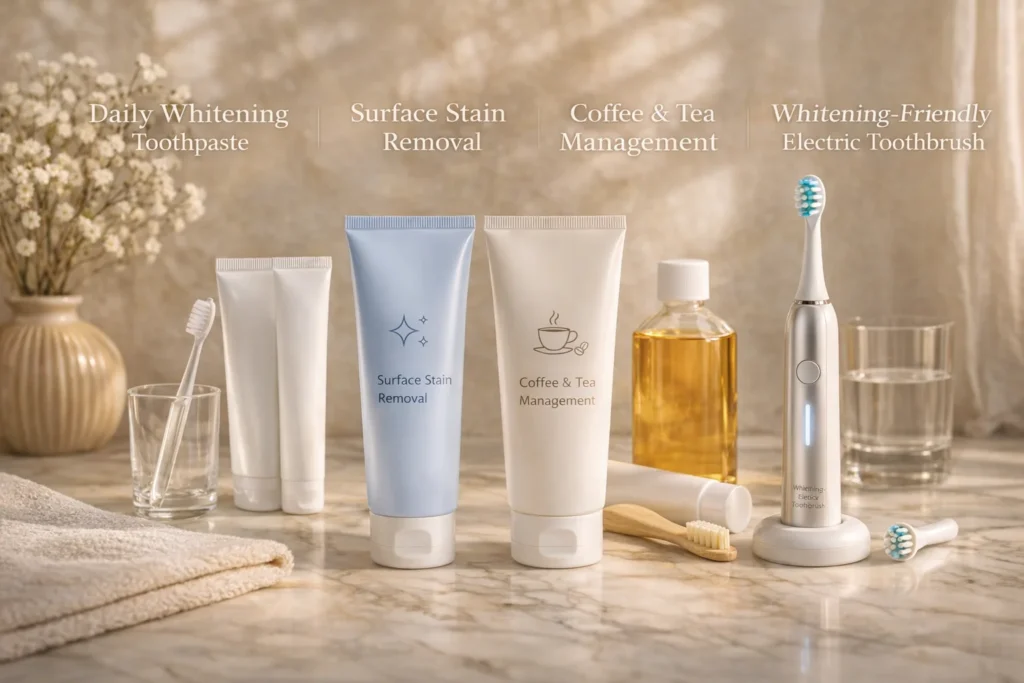
A lot of people make maintenance feel heavier and heavier because they try to turn every step into an everyday step. But sustainable maintenance depends on layering. What you do every day should be light maintenance and baseline cleanliness. Surface stain support can be added when needed. Stronger correction layers should be used with more restraint and more rhythm, not pressed onto your teeth all the time. The value of this approach is not that it looks conservative. It is that the result usually becomes much more stable.
What you really want is not just a few good-looking days. You want your teeth to look cleaner, brighter, and more polished most of the time. That kind of result usually does not come from constant intensity. It comes from a routine you can actually stick to, one that does not wear you down and does not keep forcing your teeth through the same cycle again and again. The moment you shift from “How can I go harder?” to “How can I stay steadier?” your judgment about whitening maintenance usually becomes much clearer.
If you want to see the full path more clearly, start with the complete whitening guide
If you have started realizing that your problem is no longer “Should I begin?” but “How do I keep the result from fading so fast?” then the next thing most worth reading is usually not another random product page. It is the full whitening path. Once you understand where basic brightening, surface stain control, stronger whitening, and long-term maintenance each fit, it becomes much easier to see which layer you actually need right now instead of circling around inside the same one.
If you already know which layer is holding you back, these are the better next clicks
If you are becoming more certain that the issue is not a lack of effort but one specific part of the process that has never quite been handled correctly, then your next reading direction should be more focused too. For example, if you strongly suspect that you have been choosing the wrong daily products, or you keep feeling like a certain category of product never performs the way you hoped, then moving into narrower support pages is often more useful than continuing to search for the “strongest whitening” answer in general. That way, you can more directly match the next step to the exact point where you are getting stuck.
Affiliate Disclosure:
Some of the links on this page may be affiliate links, which means we may earn a small commission if you make a purchase through them, at no extra cost to you. We only recommend products that are relevant to the topic and that we believe may be genuinely useful to you.
References and source directions:
American Dental Association (ADA): whitening product categories, toothpaste abrasives for surface stain removal, daily brushing guidance
NHS: tooth staining from coffee, tea, red wine, smoking; whitening maintenance and limitations
Mayo Clinic: twice-daily brushing guidance and clean-between-teeth daily guidance