
best toothbrush for bleeding gums
When you notice your gums bleeding, your first reaction usually is not, “I need a different toothbrush.” You usually just try to brush a little more lightly, or tell yourself that slowing down for a few days will probably help. But the part that keeps people stuck is this: a lot of the time, you are not ignoring the problem, and you are not failing to brush altogether. It is just that the toothbrush in your hand keeps trapping you in an awkward middle ground. If you brush too gently, the gumline and the spaces near your teeth never feel truly clean. If you try to brush a little more thoroughly, those same areas start to feel more sensitive and more likely to bleed. So you keep brushing every day, but you never quite reach that feeling of “clean enough without making my gums worse.”
That is exactly why the question “best toothbrush for bleeding gums” should not be reduced to “which toothbrush is the softest.” If your gums keep bleeding, what you really need is not just a brush that sounds gentle. You need a brushing approach that matches the stage you are in right now. In practical terms, that means something that can remove plaque effectively without adding extra irritation to a gumline that already feels unstable. The real issue is simple: both over-stimulation and incomplete cleaning can keep the problem going.

A lot of people shop for a toothbrush by looking for words like “soft bristles,” “gum care,” or “for sensitive gums.” But what usually determines whether a brush actually works for you is something more basic. Is your main problem that brushing feels too irritating right now, or is it that your gumline never seems to stay stable even when you do brush? Is the issue concentrated in a few spots, or does your whole mouth feel reactive? Do you need a toothbrush that makes you feel safe enough to brush properly again, or one that helps bring your long-term cleaning quality up? Those are very different situations, and they do not all need the same kind of toothbrush.
If the strongest feeling you have right now is that you tense up whenever the brush gets close to your gumline, or that you instinctively avoid certain spots because they keep bleeding, then the first thing you need usually is not a stronger cleaning tool. You need a toothbrush that helps you rebuild a stable brushing pattern. That usually means a smaller brush head, softer bristles, and an overall brushing feel that stays easy to control. The point is not to create a strong “deep-clean” sensation. The point is to make it easier for you to brush slowly along the gumline without immediately pulling back. Because once you get scared, skip spots, or start brushing around the problem, plaque and trapped debris keep staying exactly where they need the most attention, and the bleeding comes back again.
But if your issue is not really “it hurts the second I brush,” and instead it feels more like your gums stay mildly reactive, your gumline always seems to collect buildup, or brushing never leaves you feeling fully clean, then simply buying a “very soft” toothbrush may not be enough. In that case, the real problem is often not softness. It is long-term cleaning consistency. With a manual toothbrush, your angle changes, your timing changes, and your pressure changes from day to day. One day you brush carefully. The next day you rush. One day you work along the gumline. The next day you mostly skim the tooth surface. Over time, this creates a strange pattern where you feel like you are trying, but the most important edge areas in your mouth never get stable care. For that kind of situation, it may make more sense to look at a gentle electric toothbrush, especially one with a smaller brush head, smoother power delivery, and a more controlled overall brushing feel. The value there is not that it feels more advanced. The value is that it helps reduce the daily fluctuation in how well you clean.
This is where many people get confused and assume that an electric toothbrush must be too aggressive for bleeding gums. But what actually determines the experience is not whether the brush is electric. It is whether the brushing action feels steady enough, whether the brush head suits your mouth well, and whether the cleaning mode stays on the gentler side. If your gums keep reacting, what you need is not stronger stimulation. You need a method that is harder to mess up every day.
So in real life, the best toothbrush for bleeding gums usually falls into a few different categories, and they are not meant for the same kind of person.
The first category is an extra-soft manual toothbrush with a small head and a very gentle overall feel. This fits best if you are currently in the stage where brushing makes you nervous, or you have already started avoiding proper brushing because you are afraid of bleeding. Its job is not to fix everything at once. Its job is to help you brush along the gumline again without constantly pulling away.
The second category is a regular soft manual toothbrush that is simply better made, more precise, and easier to guide along the gumline. This fits people who are not in severe discomfort but still feel that their daily gumline cleaning has never been quite stable. You may not need to move to an electric toothbrush immediately, but you do need something that helps you clean the gumline and back areas more accurately instead of relying on a brush that always leaves you with a “good enough” result.
The third category is a gentle electric toothbrush. This usually makes more sense for two kinds of people: those who already know that their manual brushing quality is inconsistent, and those who have been dealing with recurring gum issues long enough to suspect that the problem is bigger than just “using the wrong soft brush.” For them, the real value of a gentle electric toothbrush is not trendiness. It is the chance to bring more consistency into daily cleaning.
The fourth category is for people who need more than a toothbrush. This matters because some bleeding is not really about brushing alone. It is about plaque, trapped debris, and hard-to-reach buildup around the gumline, in the back teeth, or between the teeth. If that is your pattern, then trying to solve everything with a toothbrush alone will eventually feel frustrating. A better toothbrush can help, but sometimes what really changes the situation is adding the right supporting tools so those hidden areas do not keep staying dirty while the gumline keeps getting irritated.
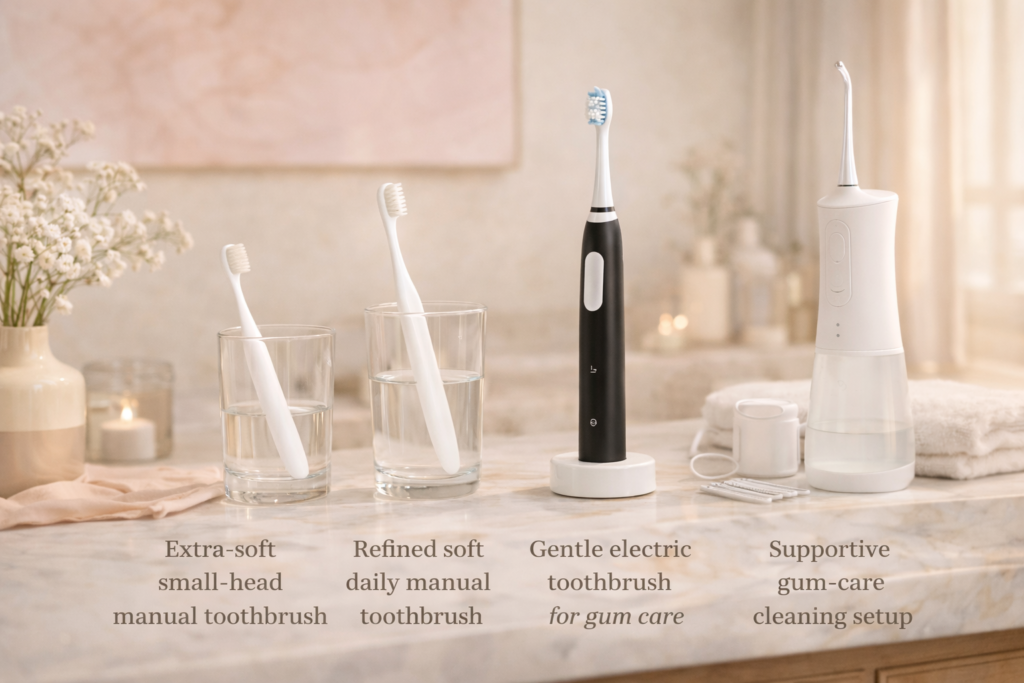
So how do you choose? The easiest way is to start by identifying what stage sounds most like you.
If your strongest problem right now is that brushing feels uncomfortable, you feel tense around the gumline, or you find yourself avoiding certain areas, start with the first category: a more gentle, smaller-head, easier-to-control manual toothbrush. Right now, you do not need stronger cleaning. You need to stop the pattern of brushing around the problem.
If you are no longer dealing with strong discomfort, but your gumline still never feels truly stable and brushing does not leave you feeling fully confident, look at the second category: a better-made soft manual toothbrush that feels smoother and works more precisely along the gumline. That is the right step when you are moving from “I can brush” to “I can finally brush well.”
If this has been recurring for a long time and you already know that your brushing quality changes too much from day to day, or you suspect you simply are not cleaning key areas well enough, then the third category deserves a serious look: a gentle electric toothbrush. That is a better fit for long-term cleaning improvement, not just temporary reassurance.
And if the problem clearly seems to collect around the spaces between teeth, the back teeth, or areas where food tends to get trapped, then do not keep asking only “which toothbrush is best.” That is when you need to move into the fourth category mindset. The toothbrush is just the foundation. What really determines whether the problem keeps coming back may be whether your whole cleaning path is finally dealing with the hidden areas too.
If you have read this far and realized that your situation is not just a matter of “switch to any softer toothbrush,” then your next step should not be choosing based only on packaging words like “gum care.” What matters more is understanding where you are getting stuck. Do you need a gentler restart, or do you need a more stable long-term cleaning tool? Is the real problem that brushing feels too irritating, or that your cleaning has never actually been complete enough to keep the gumline settled? Once you get that part right, the toothbrush you choose can finally start helping you instead of keeping you stuck in the same cycle of brushing, worrying, and repeating the problem.
Put even more simply, the real answer to “best toothbrush for bleeding gums” is never “the single best brush in the world.” It is the brush category that fits the specific stage of the problem you are in right now. If you are only in a mild sensitivity phase, an extra-soft small-head toothbrush may be enough. If you have been stuck in a long cycle of recurring gum instability, a gentle electric toothbrush may be worth much more serious consideration. And if the problem is clearly connected to trapped debris and hard-to-clean areas, then what really needs to improve may not be just your toothbrush at all, but your full cleaning system.
Once that logic becomes clear, the tool you buy has a much better chance of actually changing how brushing feels every day. Otherwise, you can keep changing toothbrushes without ever really changing the direction your gums need.
If you have already realized that this is not just about “brushing too hard,” but about a cleaning method that has never become truly stable, then the next thing worth reading is not only about the toothbrush itself, but about how to complete the full gumline-cleaning logic around it. Related support articles can help you see that more clearly.
Affiliate Disclosure:
Some of the links on this page may be affiliate links, which means we may earn a small commission if you make a purchase through them, at no extra cost to you. We only recommend products that are relevant to the topic and that we believe may be genuinely useful to readers.
Medical References:
- American Dental Association (ADA): public guidance on toothbrush selection, plaque removal, and daily oral hygiene
- NHS: brushing guidance and soft/medium toothbrush recommendations
- Mayo Clinic: gum care, oral hygiene basics, and practical patient-facing guidance